
Table of Contents
If you are reading this right now, chances are you are looking at a frightened dog, a surprising amount of blood, and a toenail that looks completely wrong.
I want to start by validating what you are feeling: seeing your dog’s toenail broken at the base is alarming. In my ten years of veterinary practice, few minor injuries provoke as much panic in owners as a base-level nail fracture. It looks gruesome, it bleeds profusely, and the reaction from the dog—usually high-pitched yelping or panicked limping—can make you feel like it’s a life-threatening emergency.
While a broken nail is rarely life-threatening, I want to be clear: a break at the base is significantly different from a chipped tip. This is an injury to the structural anchor of the nail. It involves live tissue, exposed nerves, and the bone of the toe itself. It is not something that simply “grows out” in a few days.
This article focuses exclusively on traumatic fractures where the nail has broken, split, or avulsed right at the the nail bed (the base)—the point where the nail enters the toe. We are not discussing fungal infections or simple grooming errors here. We are discussing a painful, acute injury that needs to be handled with care and respect for your dog’s pain threshold.
What Does It Mean When a Dog’s Toenail Breaks at the Base?
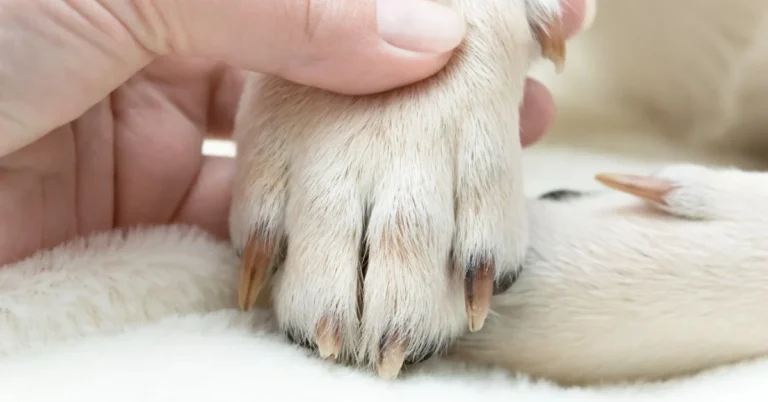
To understand why this injury is so severe, we have to look at the anatomy of your dog’s foot. A dog’s nail isn’t just dead keratin like a human fingernail (except for the very tip). The nail is a hard shell protecting a living core called the “quick” (or the ungual process). This core is rich in blood vessels and nerves and is actually attached to the bone of the toe (the distal phalanx).
When a toenail breaks at the tip, it’s annoying. When it breaks at the base, the hard shell has been wrenched away from that sensitive core, or the core itself has been damaged.
A base-level break means the structural integrity of the nail is gone. Often, the hard shell is cracked all the way up to the skin line, or the nail is bent at a 90-degree angle, held on only by a thin strip of tissue. This leaves the “quick” exposed to the air, carpet fibers, and dirt. Because the break is at the root, every time your dog takes a step, the pressure of the floor pushes against the mobile, broken fragment, transmitting shockwaves of pain directly into the toe bone.
Why a Broken Toenail at the Base Is So Painful
Clients often ask me, “Is he being dramatic? It’s just a toenail.”
My answer is always no. Your dog is not being dramatic.
Imagine ripping your fingernail backwards, all the way down to the cuticle, exposing the raw nail bed underneath. Now, imagine having to walk on that finger without any shoes. That is the sensation your dog is experiencing.
The pain comes from three distinct sources:
- Direct Nerve Exposure: The quick is packed with nerve endings. When the hard shell breaks at the base, those nerves are stripped of their protection. Air currents, temperature changes, and physical contact trigger sharp, shooting pain.
- Mechanical Leverage: If the broken piece of nail is still attached (hanging loose), it acts like a lever. Every time that hanging piece brushes against the floor or bedding, it twists the raw, exposed tissue at the base. This is often why dogs won’t put their foot down—the instability is excruciating.
- Inflammation: The body immediately sends blood and inflammatory cells to the base of the nail to start healing. This causes swelling in a very tight space, leading to a throbbing sensation that makes it difficult for the dog to rest.
Dog Broken Toenail at Base – What to Do Immediately
If you have just discovered the injury, take a deep breath. Your goal right now is not to “fix” the nail—that is my job. Your job is damage control and pain management through restriction.
Keep Your Dog Calm and Restrict Movement
The single biggest mistake I see owners make is encouraging the dog to “walk it off” or trying to get a better look while the dog is thrashing.
Stop everything. If you are on a walk, carry your dog or walk them slowly to the car on the grass (which is softer than pavement). Once home, confine your dog to a small area or crate. Adrenaline can mask pain initially, but once your dog settles, the throbbing will start.
Restricting movement is critical because running or jumping can turn a clean break into a jagged tear that damages the surrounding skin. If your dog is licking the area frantically, you must stop them. Licking introduces oral bacteria to the deep tissues of the toe, which can complicate healing later.
Managing Bleeding Safely
Some links in this guide may be affiliate links. This does not affect our content or recommendations
Base-level nail breaks are notorious for looking like a crime scene. The blood supply to the quick is robust.
If the nail is actively dripping blood:
- Apply Pressure: Use a clean gauze pad or washcloth. Hold it directly against the bleeding base for a full 5 minutes. Do not peek every 30 seconds; continuous pressure is required for clotting.
- Styptic Powder: If you have Kwik Stop or a similar styptic powder ,this is the time to use it. If you don’t, cornstarch or flour can work as a makeshift clotting agent.
- Don’t Panic: It looks like a lot of blood, but it is rarely enough to cause blood loss anemia in a healthy dog. The blood mixes with saliva and spreads on the floor, making the volume appear greater than it is.
Protecting the Injured Nail Temporarily
You need to protect the foot only long enough to get to the vet. Do not attempt to create a professional bandage; tight bandages cut off circulation and can cause necrosis (tissue death).
A clean, thick sock is usually sufficient. Slip the sock over the paw and tape it loosely around the hock (ankle) using medical tape—do not tape it too tight. This protects the exposed nerves from the air and keeps blood off your car upholstery. If the nail is hanging loosely, the sock keeps it from snagging on things during transport.
What NOT to Do with a Broken Toenail at the Base
In my years of practice, the worst complications I treat are usually not from the nail break itself, but from well-meaning owners trying to treat it at home.
1. Do NOT pull the nail off yourself. There is a pervasive myth that you should just “yank” the hanging nail. Please, never do this. As established, the nail bed is full of nerves. Pulling a nail broken at the base without anesthesia or heavy sedation is torture for the animal. It can also damage the germinal cells (the cells responsible for growing a new nail), causing permanent deformity.
2. Do NOT cut the nail with home clippers. If the nail is dangling, your instinct might be to trim it. However, the pressure of the clippers squeezing the nail sends a shockwave of pain up the quick. Unless the piece is hanging by a literal thread of dead keratin, leave it alone.
3. Do NOT use human pain relievers. Never give your dog Tylenol (acetaminophen), Ibuprofen, or Aspirin. These can be toxic or fatal to dogs. Acetaminophen, in particular, causes liver failure and alters red blood cells. Wait for your veterinarian to prescribe safe, species-appropriate pain control.
4. Do NOT use household glues. I have had clients try to Super Glue a broken nail back together. This traps bacteria inside the wound and burns the raw tissue. The broken shell cannot be saved; it must eventually be removed, not glued.
Is a Broken Toenail at the Base an Emergency?
This is a nuanced question. A broken nail is rarely a “life-and-death” emergency like bloat or heatstroke. However, it constitutes an “urgency of pain.”
You should see a veterinarian within 12 to 24 hours. Waiting several days is not acceptable for a few reasons:
- The Pain: The dog will be in constant discomfort until the damaged, unstable fragment is removed.
- The Infection Risk: A break at the base opens a pathway directly to the bone. Left untreated, bacteria can migrate up the nail bed and infect the toe bone (osteomyelitis), which is a difficult and expensive condition to treat.
- The Snag Risk: A loose nail catches on blankets and carpets. If it snags, it can rip the surrounding healthy skin, requiring stitches in addition to nail treatment.
If your dog is trembling, refusing to eat, or cannot sleep due to pain, consider it an immediate visit, even if that means an ER trip.
Healing Expectations for a Base-Level Toenail Injury
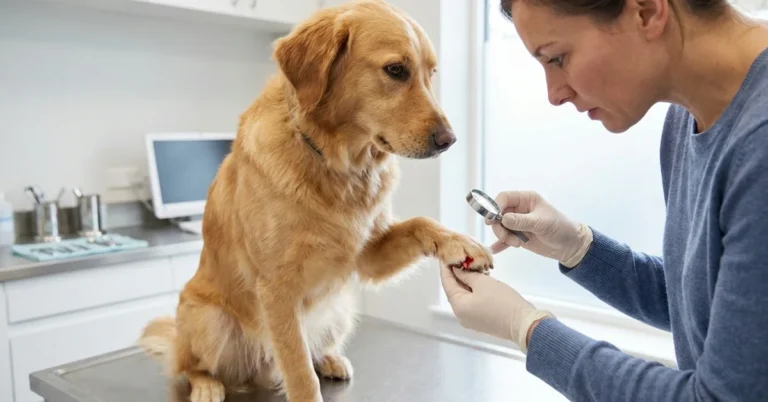
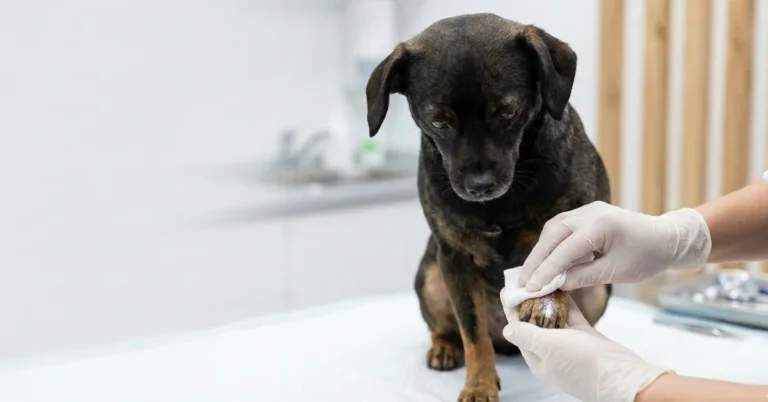
When you bring your dog to the clinic, my procedure is straightforward. I will sedate your dog or use a local nerve block to ensure they feel no pain. Then, I carefully remove the damaged portion of the nail shell back to the break, leaving the healthy nail bed (the quick) exposed.
Here is what you can expect during recovery:
The First 48 Hours: Once the unstable shell is removed, your dog will likely feel immediate relief. The “lever” causing the pain is gone. We typically send dogs home with a light bandage, pain medication, and an E-collar (cone) to prevent licking.
The “Sensitive Nub” Phase (Weeks 1-2): The exposed quick will look like a raw, pink/red fleshy nub. It will slowly dry out and form a hard, callous-like layer. During this time, the toe is tender. You should restrict walks to short leash breaks and keep the foot dry.
Regrowth (Months 1-4): Toenails grow slowly. It can take several months for the hard outer shell to fully re-grow from the base to the tip. As it grows, the new nail might look uneven or ridged initially—this is normal.
Permanent Changes: Occasionally, if the trauma at the base was severe enough to damage the nail matrix (the root), the nail may grow back thicker, crooked, or strangely shaped. In rare cases, it may not grow back at all.
Preventing Future Base-Level Toenail Injuries
Once you have dealt with this injury, you never want to do it again. While accidents happen, most base-level breaks I treat are caused by nails that were too long to begin with.
Length Management is Key: When a nail is long, it hits the ground first before the paw pad. This jams the nail back into the toe bed with every step. Furthermore, a long nail acts as a long lever arm—it takes very little force to snap it at the base if it gets caught in a deck board or carpet loop.
Safe Walking Surfaces: Be cautious on metal grates, escalators, or widely spaced wooden decks. These are prime traps for canine toenails.
Regular Checks: Check your dog’s paws weekly. Look for hairline cracks or splits at the base that haven’t broken through yet. Early detection allows us to trim the nail back safely before a catastrophic break occurs.
Frequently Asked Questions
Is a broken toenail at the base serious?
It is serious in terms of pain and potential for infection, but it has an excellent prognosis. It is not life-threatening, but it requires veterinary intervention to ensure the bone is protected and the pain is managed.
Will the nail grow back?
Yes, in the vast majority of cases, the nail will grow back. It takes patience—often 3 to 6 months for full length—but the keratin will regenerate as long as the germinal cells at the root weren’t destroyed by the trauma.
Can I trim a broken toenail at the base?
No. Do not attempt this at home. The margin for error is non-existent, and you risk cutting live tissue or crushing the exposed nerve. This is a surgical procedure that requires sterile tools and often a local anesthetic.
Should my dog walk with this injury?
Strictly for toileting purposes only. Long walks, running, or play should be completely suspended until your veterinarian gives the all-clear, typically after the exposed quick has dried out and is no longer sensitive (about 7-10 days).
Final Veterinary Advice for Dog Owners
If your dog has broken a nail at the base, do not beat yourself up. Dogs run, dig, and play; this is a risk inherent to being a dog.
However, please do not try to “wait and see” with a base injury. The difference between a dog who suffers for a week and a dog who is comfortable tomorrow is a simple vet visit to remove the broken fragment.
Focus on keeping your dog calm, stopping the bleeding, and getting them to the clinic safely. We have the tools to numb the area and fix the problem in minutes. Your dog trusts you to make the pain stop, and the safest way to do that is to let a professional handle the removal.
Disclaimer: This article is for informational purposes only and describes general veterinary practices. It does not constitute specific medical advice for your individual pet. If your dog is injured or in pain, please contact your local veterinarian immediately.
3 Comments