
Dog Nail Discoloration Causes | What Pet Owners Should Know
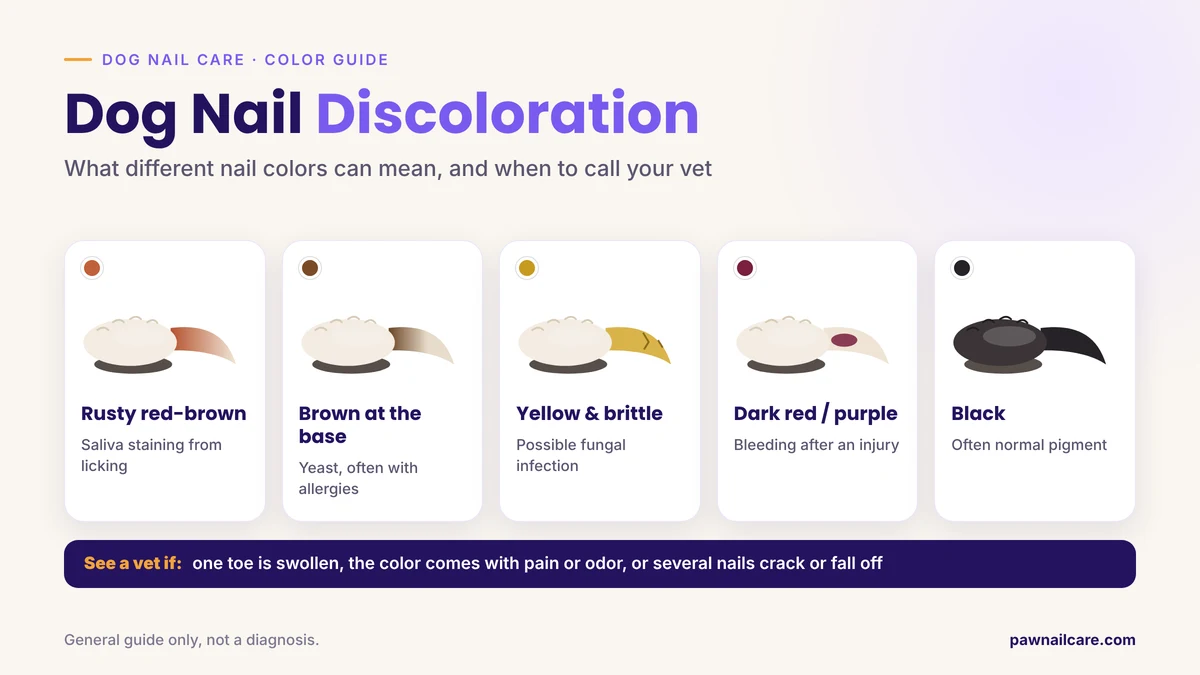
Table of Contents
This article contains affiliate links. If you buy through them, we may earn a small commission at no extra cost to you. As an Amazon Associate I earn from qualifying purchases.
You are wiping your dog’s paws after a walk and notice something new: a white nail has turned rusty brown, or a toe looks darker than the others. It is natural to wonder whether it is dirt, an infection or something more serious.
Nail discoloration in dogs can range from completely harmless to a sign that needs a vet’s attention. Sometimes it is just a stain from licking or normal pigment. Other times, it points to an infection, an injury or, rarely, a tumor.
This guide explains the most common causes of nail color changes and the signs that mean you should call your vet. It focuses on the “why,” not on treatment.
How we wrote this guide: The Dog Nail Care team researched this article from published veterinary sources, which are listed at the end. We are dog owners and researchers, not veterinarians. Use this guide alongside your vet’s advice, not instead of it.
What Is Considered Normal Nail Color in Dogs?
Before you can spot what is abnormal, you need to know what is normal for your dog. Dog nail color varies a lot, and much of it depends on the color of the skin and coat around the toes.
- White or clear nails: Common in dogs with light-colored paws. You can often see the pink quick (the living core with blood vessels and nerves) inside the nail.
- Black or dark nails: These contain more pigment. You cannot see the quick from the outside.
- Mixed nails: Many dogs have some white and some black nails, or a single nail that is part black and part white.
Nail color can also change as a puppy grows. Some breeds have nails that are white as puppies and turn black as they grow up.
The key rule: what matters is a change from your dog’s own normal. If your dog has always had striped or mixed nails, that is their baseline.
What Does Nail Discoloration in Dogs Indicate?
A dog’s nail is made of keratin, a hard protein, and it grows slowly from the base, about 1 to 2 mm per week. Because of this, the location of a color change can give a clue. A change at the very tip is older nail. A change that starts at the base is in the newest growth.
Discoloration usually comes from one of three places:
- On the surface: Staining from saliva, dirt or the environment.
- In the nail itself: An infection or a disease that changes how the nail grows.
- Under the nail: Bleeding or inflammation in the living tissue beneath the hard shell.
A simple first question is: Is the color on the nail, or in the nail? Surface stains often fade or grow out. Color that is part of the nail, especially with other changes, needs a closer look.
Here is a quick guide to what different colors may mean. It is a starting point, not a diagnosis.
| Color you notice | Common possible causes | Check with your vet if |
|---|---|---|
| Rusty red or pinkish-brown | Saliva staining from licking (porphyrin) | Your dog keeps licking the paws |
| Brown at the base | Yeast (Malassezia), often in dogs with allergies | There is itching, redness or odor |
| Yellow to brown, brittle | Fungal nail infection | Several nails are affected |
| Dark red or purple | Bleeding or inflammation after an injury | The toe is painful, swollen or limping |
| Black | Often normal pigment; rarely a nail bed tumor | It is new, on one toe, and the toe is swollen |
Common Dog Nail Discoloration Causes
These are the most common reasons a dog’s nails change color.
Saliva Staining From Licking
This is a very common cause of the reddish-brown or “rusty” color on light-colored nails and paw fur. Dog saliva and tears contain natural pigments called porphyrins, which come from the breakdown of red blood cells. When a dog licks the same spot again and again, these pigments stain light fur and nails pink, red or brown.
The stain itself is harmless, but the licking is a clue. Dogs often lick their paws because of itchy skin, allergies, parasites, pain or habit. If your dog licks a lot, the reason for the licking is what needs attention.
Yeast and Fungal Infections
A yeast called Malassezia lives on normal dog skin, but it can overgrow, especially in dogs with allergies. When it affects the skin fold around the nail, it often causes a brown color on the nail and the nearby hair. The paws may also be itchy, red or greasy.
A fungal nail infection (onychomycosis) usually affects several nails and causes yellow to brown discoloration of the nails and surrounding skin. The nails may also become brittle. These infections need a vet’s diagnosis and treatment, which can take several months. Read more in our guide to dog nail infection treatment.
Injury and Trauma
Trauma is the most common cause of nail problems in dogs. A nail caught in a door, snagged on carpet or hit during play can bleed or bruise inside, which may show as a dark red or purple color, especially in white nails. An injured nail may also crack or grow back with a different shape or color. Our guide to dog nail regrowth stages explains what to expect as a damaged nail grows out.
Dirt and Environmental Staining
Mud and dirt can pack into rough nails or around the nail base and look like a dark discoloration. A good test is to gently wash the nail with water and a mild, pet-safe soap. If the color comes off, it was dirt. If it stays, it is part of the nail.
Itchy Paws From Fleas and Biting Insects
Anything that makes a dog itchy can lead to paw licking, and licking leads to saliva staining. Flea bites can trigger skin allergies in some dogs, and mosquito and fly bites can also cause itching. Keeping your dog on a parasite preventive your vet recommends can help reduce bites and itch-driven licking.
K9 Advantix II is one over-the-counter topical option for dogs. Its label says it repels and kills fleas, ticks and mosquitoes and repels biting flies. It contains permethrin, which is toxic to cats. Never use it on a cat, and keep cats away from a treated dog while the product dries. Ask your vet which parasite product is right for your dog, especially if your dog is very young, old, pregnant or on other medicines.
Affiliate link — we may earn a commission at no extra cost to you. Price may change.
Nail Care and Hygiene Factors
How you care for your dog’s nails and paws can affect how they look.
- Overgrown nails: Long nails are more likely to snag, crack and break, and injured nails can bleed or bruise inside. Regular trimming keeps nails shorter and less likely to be damaged.
- Regular trims: Trimming removes older nail at the tip, which can make the nail look cleaner. Use sharp clippers made for dogs, such as these dog nail clippers.
- Moisture and hair between the toes: Paws that stay damp, or long hair that traps dirt and moisture, can make staining more likely. Drying the paws after walks and keeping toe hair tidy can help.
Trimming nails and drying paws at home?
Our paw and nail care list has nail trimming tools, paw cleaning basics and other everyday picks many owners keep at home.
Browse the paw care list on Amazon (paid link)Natural Pigmentation and Age-Related Changes
Not every color change is a problem.
- Normal pigment: Black, white and mixed nails are all normal. Dark-skinned dogs usually have dark nails.
- Puppy changes: Some dogs have nails that start out white and darken as they grow.
- Aging: Veterinary sources note that nail color may also change simply as a dog gets older. These changes are usually slow and affect the nails evenly.
A slow, even change across many nails, with no pain, licking, swelling or nail damage, is usually less worrying than a sudden change in one toe.
General Health-Related Influences
Sometimes nail changes are linked to a health problem. We cannot diagnose anything here, but these are conditions vets consider:
- Allergies: Allergic dogs often lick their paws and are more likely to get yeast overgrowth, which can cause red and brown nail color.
- Symmetric lupoid onychodystrophy (SLO): An uncommon condition, thought to be immune-related, where the immune system attacks the area where nails grow. It usually affects many or all nails. Nails may break or fall off and grow back brittle, misshapen and discolored. Some breeds, such as German Shepherds, Rottweilers, Gordon Setters and Bearded Collies, seem more prone to it.
- Other diseases: Hormone and immune problems can make nails more likely to get infected or grow abnormally. If several nails on more than one paw look abnormal, ask your vet about testing.
When Nail Discoloration Is a Cause for Concern
Many color changes are harmless, but these signs mean you should contact your vet:
- A sudden change after an injury: A nail that turns dark red or purple, especially with limping or pain, may have bleeding or bruising inside.
- Changes in texture: Discoloration together with brittle, crumbly, cracked or thickened nails can mean an infection or nail disease.
- Swelling, redness, discharge or a bad smell around the nail base.
- Constant licking or chewing of one paw or nail.
- Several nails on more than one paw breaking, splitting or falling off.
- One toe that is swollen, has a sore, or loses its nail. When only one nail is affected, vets usually think of trauma first, but they also check for a tumor.
About Nail Bed Tumors
Tumors of the toe are not the most common cause of nail color changes, but they are important to rule out. The two most common types are squamous cell carcinoma and melanoma. Squamous cell carcinoma makes up more than half of all toe tumors and is seen more often in large, dark-coated dogs such as Labrador Retrievers and Rottweilers. Some melanomas at the nail base look black.
Signs can look like a stubborn infection: a swollen toe, a sore, bleeding, licking, limping, or a nail that splits or falls off. A black nail on its own is usually normal pigment. But a new dark spot, a swollen toe or a nail problem that does not heal should always be checked by your vet.
Observing Nail Discoloration at Home
You see your dog every day, so you are the best person to notice early changes. A short, regular check helps.
What to look at:
- The skin around the nail: Is it red, swollen, wet or stained?
- Where the color starts: At the base (newer growth) or only at the tip (older nail)?
- How many nails: Is it one nail or many? Changes in one toe point more toward injury or a local problem. Changes in many nails point more toward infection, allergies or nail disease.
- The texture: Is the nail smooth, or is it brittle, cracked or crumbly?
How often to check: Once a month is a good routine, for example when you trim the nails. Use good light, such as daylight or a flashlight.
Track changes: If you see a spot or color change, take a clear photo. Repeat it every week or two. Photos help your vet see whether something is growing out, spreading or changing shape.
What Dog Owners Should NOT Assume About Nail Discoloration
Don’t assume it is just dirt. If gentle washing doesn’t remove the color, it is part of the nail. Hard scrubbing won’t fix it and may hurt your dog.
Don’t assume the worst. A black line or dark nail is often normal pigment. Tumors are possible, but staining, infection and injury are far more common reasons for a color change.
Don’t self-treat with human products. Do not use bleach, human antifungal creams or other harsh chemicals on your dog’s nails without your vet’s advice. Dogs lick their paws, and the wrong product can irritate the skin or be harmful if swallowed.
What About Coconut Oil for Paws?
Some owners use coconut oil on dry, cracked paw pads. Veterinary sources say it is unlikely to cause problems on paws unless your dog licks off a lot, but the evidence for its benefits in dogs is weak. It will not remove nail stains or treat an infection. If your dog licks the oil off, it can also cause more licking, which is the opposite of what you want for stained paws.
If your dog’s paw pads are simply dry, a small amount rubbed in well is a simple option some owners like. If you want to try it, this is the one we link to:
Affiliate link — we may earn a commission at no extra cost to you. Price may change.
Frequently Asked Questions
Is nail discoloration normal in dogs?
Some color differences are completely normal, such as black, white or mixed nails, or light saliva staining. But a new color change in one toe, or a change with pain, swelling, odor, brittle nails or constant licking, should be checked by your vet.
Can a dog’s nail color change over time?
Yes. Some puppies have white nails that turn black as they grow, and nail color can also change as a dog ages. Normal changes are usually slow and even. Sudden changes are more likely to have a cause, such as an injury or infection.
Why are my dog’s white nails turning red or brown?
The most common reason is saliva staining from licking. Dog saliva contains natural pigments called porphyrins that stain light nails and fur reddish-brown. A brown color at the nail base can also be caused by yeast, especially in dogs with allergies. If your dog licks a lot, ask your vet why.
Should discolored nails be trimmed?
If the nail is too long, yes. Regular trimming keeps nails short and removes older nail at the tip. If the nail is painful, cracked, bleeding or infected, let your vet handle it instead of trimming it yourself.
Can nail discoloration go away on its own?
A surface stain from dirt can wash off, and a saliva stain on the nail usually grows out once the licking stops, because nails grow slowly from the base. Discoloration caused by an infection, nail disease or other health problem usually needs treatment.
Final Thoughts
A change in nail color is rarely an emergency, but it is worth paying attention to. Most cases come down to saliva staining, yeast, an injury or normal pigment.
Keep the paws clean and dry, keep the nails trimmed, and check them once a month. If a color change comes with pain, swelling, odor, brittle nails or constant licking, or if it affects just one swollen toe, ask your vet to take a look.
Sources
We used these veterinary and expert sources for this guide:
- American Kennel Club – Why Is My Dog’s Fur Changing Color?
- University of Illinois College of Veterinary Medicine – Malassezia Dermatitis in Dogs and Cats
- PetMD – Nail Infections in Dogs
- FirstVet – Abnormal Nail Color in Dogs
- Clinician’s Brief – Claw & Claw Bed Diseases in Dogs and Cats
- VCA Animal Hospitals – Symmetric Lupoid Onychodystrophy in Dogs
- VCA Animal Hospitals – Squamous Cell Carcinomas in Dogs
- PetMD – Tumors on Dog Paws
- Animal Surgical Center of Michigan – Digital Tumors
- PetMD – Advantage, K9 Advantix II and Advantage Multi
- Kinship – Can I Put Coconut Oil on My Dog?
Disclaimer: This article is for general information only. It was written by the Dog Nail Care team, who are not veterinarians, and it is not a substitute for advice, diagnosis or treatment from your veterinarian. If your dog is in pain, bleeding or showing signs of infection, contact a vet right away.


3 Comments