Dog Labor Signs: How to Tell Your Dog Is Going Into Labor and How Long It Lasts
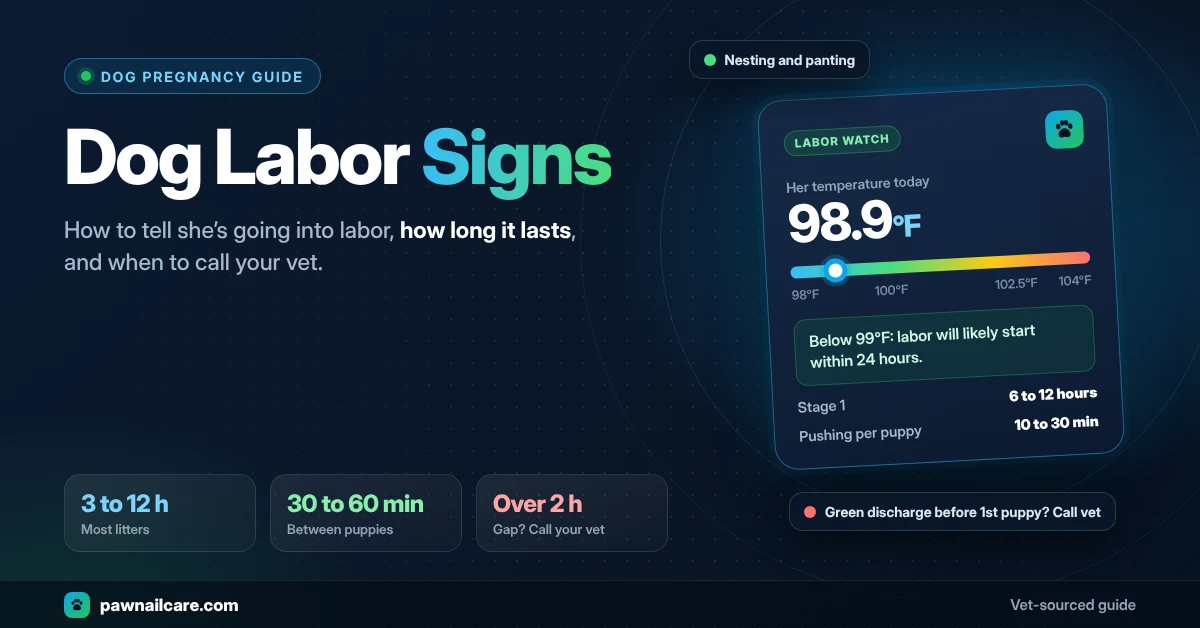
How can you tell your dog is going into labor? Most dogs show clear signs in the last day before birth. Her temperature drops below 100°F, she digs and builds a nest, she can’t settle, and she pants or shivers. Many dogs also stop eating. Once she starts pushing, most dogs deliver the whole litter in about 3 to 12 hours.
This guide explains every sign, how long each stage of labor lasts, how to help her, and the exact points when you need to call your vet. All the numbers come from veterinary sources, listed at the end.
Key takeaways:
- Signs labor is close: a temperature drop, nesting, restlessness, panting, shivering and eating less.
- Stage 1 usually lasts 6 to 12 hours, but it can last up to 24 to 36 hours.
- Puppies usually arrive 30 to 60 minutes apart, and most litters take 3 to 12 hours in total.
- Call your vet if she strains hard for 20 to 30 minutes with no puppy, or if more than 2 hours pass between puppies.
- Green or black discharge before the first puppy is an emergency. Call your vet right away.
Not sure of her due date? Our free Dog Pregnancy Calculator works it out from the breeding date. If you’re not sure she’s pregnant yet, start with our guide on how to tell if your dog is pregnant.
Please note: this guide is based on veterinary sources, but it doesn’t replace your vet. Keep your vet’s daytime and emergency numbers close as her due date gets near.
Signs Your Dog Is Going Into Labor Soon
Most dogs show a mix of the signs below in the last day or so before birth. Not every dog shows all of them, and some keep eating right up to the end, according to VCA Animal Hospitals. Look at the signs together, not one at a time.
- Her temperature drops. A dog’s normal temperature is 100 to 102.5°F. In the last 24 hours before birth, it usually drops below 100°F, and often below 99°F, according to Cornell University and PetMD.
- She starts nesting. She may dig, scratch or shred her bedding to make a nest. VCA notes that nesting can go on for up to 24 hours.
- She can’t settle. Pacing, getting up and lying down again, and looking uncomfortable are common in early labor, according to the Merck Veterinary Manual and Veterinary Partner.
- She hides or looks for a quiet spot. Many dogs head for a quiet corner or the whelping box.
- She eats less or refuses food. Some dogs also lose interest in water, according to Dogster (reviewed by a vet). Not every dog stops eating.
- She pants. Panting, even while she’s resting in a cool room, is a common early sign (Cornell).
- She shivers or trembles. Veterinary Partner lists shivering as a normal part of early labor.
- She vomits. Some dogs vomit as labor starts (Merck).
- She licks her genitals a lot. Extra licking in the hours and days before labor is common (Dogster).
- She becomes clingy. Some dogs follow their owner around, lean on them or whine (Dogster). Others would rather be left alone.
- You see a little discharge. A clear, watery discharge or a small amount of red-brown mucus can appear in early labor (Merck, PDSA). Green, black or bloody discharge before the first puppy is not normal. See the vet checklist below.
- Her belly feels firm and her nipples get bigger. In the last few days, her belly may feel hard during contractions, and her nipples may fill with milk (Dogster).
Signs Days Before vs Hours Before Labor
The signs tend to come in a rough order. This table shows what you may see and when.
| When | What you may see |
|---|---|
| From about day 55 | Start watching her closely. As the due date gets near, take her temperature every day. |
| A few days before | Bigger nipples, sometimes with milk. More nesting and extra licking. |
| About 24 hours before | Her temperature drops below 100°F, often below 99°F. |
| About 6 to 12 hours before | Restlessness, nesting, panting, shivering, not eating and sometimes vomiting. This is stage 1 labor. |
| Minutes before a puppy | Hard straining and a clear or white fluid sac at the vulva. A puppy should follow very soon. |
Sources for the table: day 55 and the days-before signs from Dogster; daily temperature checks from PetMD; the temperature drop and the fluid sac from Cornell; stage 1 timing from Cornell and PDSA.
Dog Temperature Before Labor
Taking her temperature is one of the simplest ways to tell that labor is close. The drop is short, so a steady routine makes a big difference.
How to Check Her Temperature
Use a digital rectal thermometer. As her due date gets near, PetMD advises taking her temperature every day. Write down each reading along with the time.
Cornell notes that the drop usually lasts only about 8 hours, so it’s easy to miss. Checking more than once a day gives you a better chance of catching it. If you’ve never taken a dog’s temperature, ask your vet to show you before the due date.
Dog Labor Temperature Chart
| Her temperature | What it means | What to do |
|---|---|---|
| 100 to 102.5°F | Normal for a dog | Keep checking every day |
| Below 100°F, often below 99°F | Labor will likely start within 24 hours | Get the whelping area ready and stay close |
| No labor 24 hours after the drop | Labor may be delayed | Call your vet |
| Above 103°F | Fever | Call your vet |
Sources for the chart: normal range and the drop from Cornell; below 100°F from PetMD and Veterinary Partner; below 99°F, the 24-hour rule and the 103°F limit from VCA: Problems at Birth.
Temperature is a guide, not a promise. Read it together with her behavior, not on its own.
The 3 Stages of Dog Labor
Dog labor has three stages. Stages 2 and 3 repeat for every puppy, so they go back and forth until the last puppy is born (Cornell, PetMD).
| Stage | What happens | How long | Call your vet if |
|---|---|---|---|
| Stage 1: getting ready | Contractions start, but you won’t see her push. She nests, pants and can’t settle. | Usually 6 to 12 hours, up to 24 to 36 hours | It lasts over 24 hours and she hasn’t started pushing |
| Stage 2: pushing and puppies | You see her strain, and a puppy is born. | 10 to 30 minutes of pushing for each puppy | She strains hard for 20 to 30 minutes with no puppy |
| Stage 3: the placenta | The placenta (afterbirth) comes out. | Usually about 15 minutes after each puppy | Bloody or smelly discharge in the days after birth |
Stage 1: Getting Ready
In stage 1, her uterus starts to contract, but you won’t see her push yet (PDSA). This is when you’ll notice the signs from the list above: restlessness, nesting, hiding, panting, shivering, eating less and sometimes vomiting.
Stage 1 usually lasts 6 to 12 hours, but it can go on for up to 24 to 36 hours, especially in a first-time or nervous mother (PDSA, Cornell, PetMD). The Merck Veterinary Manual gives a range of 12 to 24 hours. If stage 1 goes past 24 hours and she still isn’t pushing, call your vet (Merck).
Stage 2: Pushing and Puppies
Stage 2 starts when you can see her strain. Her belly tightens as she pushes. Often the first thing you’ll see is a clear or white fluid sac at the vulva, which means a puppy should arrive very soon (Cornell).
With strong contractions, the first puppy should arrive within 20 to 30 minutes (PDSA). If her contractions are weak and nothing happens for 1 to 2 hours, call your vet, according to Cornell’s guide to difficult births.
Each puppy usually takes 10 to 30 minutes of pushing (PetMD, Veterinary Partner). Puppies can come out head first or tail first, and both are normal (Cornell, PDSA).
Stage 3: The Placenta
After each puppy, a placenta (afterbirth) comes out, usually about 15 minutes later (PDSA). Each puppy has its own placenta. It’s common for two puppies to come first and then two placentas (Cornell).
Most mothers eat the placentas. Cornell says this neither helps nor harms her, but it often causes diarrhea. In a big litter, PDSA advises not letting her eat too many, because it can cause vomiting or diarrhea. You can quietly take some away.
Try to count the placentas. If you think one is missing, tell your vet, because a placenta left inside can lead to a womb infection later (PDSA).
How Long Does It Take a Dog to Have Puppies?
Most dogs deliver the whole litter in about 3 to 12 hours, and many finish within about 6 hours. Puppies usually arrive 30 to 60 minutes apart, with 10 to 30 minutes of pushing for each one. The whole birth should never take longer than 24 hours (PDSA, Merck, PetMD).
Stage 1 comes before all of this and can take 6 to 12 hours or more. So from the first signs to the last puppy, labor can take most of a day.
| Part of labor | Normal time | Call your vet if |
|---|---|---|
| Stage 1, before pushing | 6 to 12 hours, up to 24 to 36 hours | Over 24 hours with no pushing |
| First puppy, strong contractions | Within 20 to 30 minutes | 20 to 30 minutes of hard straining and no puppy |
| Pushing for each puppy | 10 to 30 minutes | 20 to 30 minutes of hard straining and no puppy |
| Time between puppies | 30 to 60 minutes, up to 2 hours | More than 2 hours |
| The whole litter | 3 to 12 hours, often about 6 | Over 24 hours, or you think puppies are left inside |
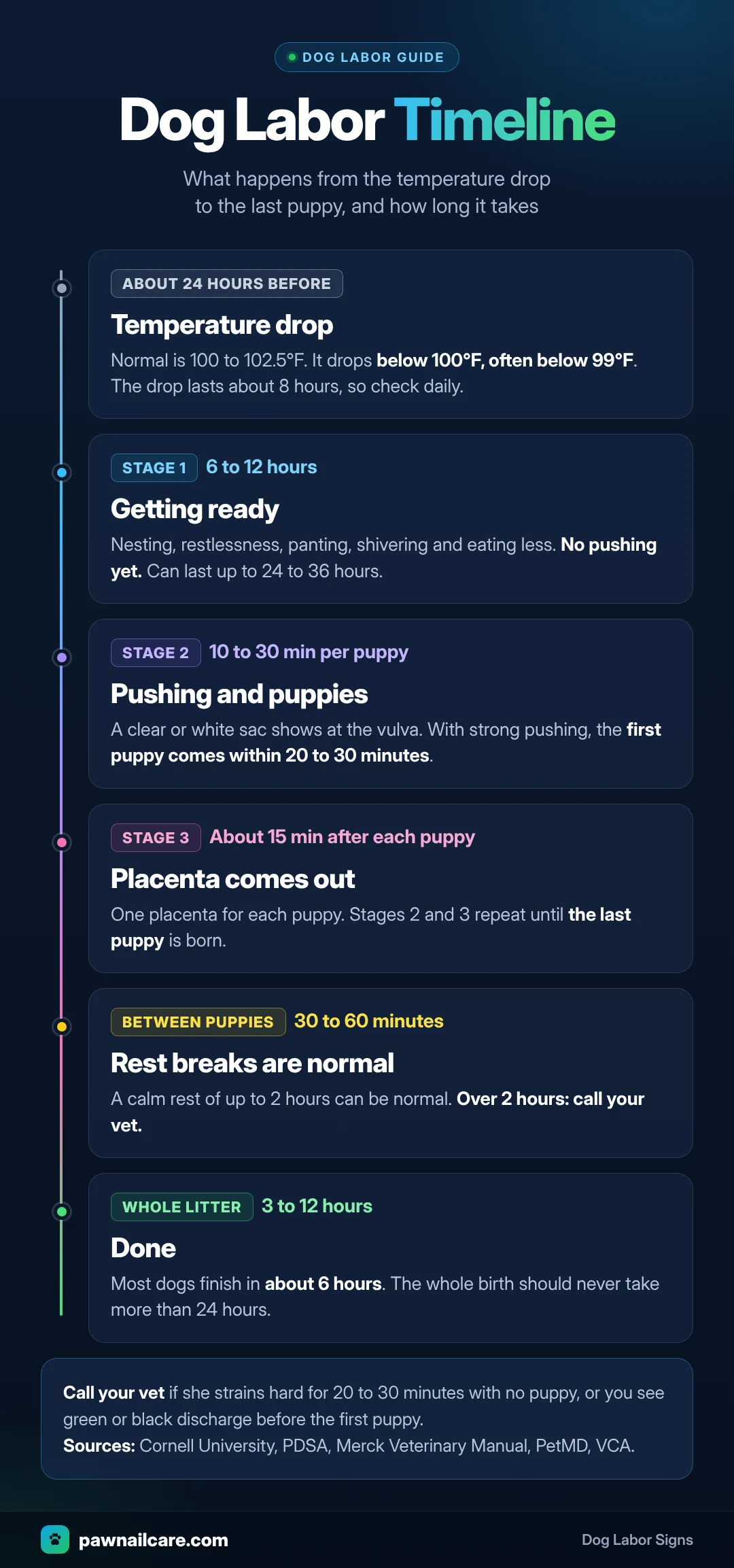
Sources for the table: Merck, PDSA, PetMD, Cornell and Veterinary Partner.
The Merck Veterinary Manual says an ideal delivery is finished in about 7 to 9 hours. Some variation is normal. What matters most is that she keeps making progress.
Short rests between puppies are normal too. If she’s calm and not straining, PDSA says a gap of up to about 1.5 hours is fine, and Cornell says up to 2 hours can be normal. Past 2 hours, call your vet.
Can a Dog Be in Labor for Days?
No. A long stage 1 can stretch to about 24 to 36 hours, but labor should not go on for days. Call your vet if stage 1 goes past 24 hours without pushing, or if the whole birth goes past 24 hours (Merck, PDSA). You should also call if her temperature dropped more than 24 hours ago and labor still hasn’t started (VCA).
Do Breed and Litter Size Change How Long It Takes?
Yes. VCA notes that breeds with slim heads, such as Shelties, Collies and Dobermans, can finish in 2 to 3 hours. Breeds with large heads or flat faces often take breaks between puppies.
Litter size matters too. Cornell says that a large litter of more than 8 puppies can tire the uterus, and that small breeds such as Chihuahuas and Yorkshire Terriers may have very small litters with oversized puppies. Both can make birth harder. If your dog fits one of these groups, talk to your vet about a plan before her due date.
When to Call Your Vet Right Away
Most dogs give birth without any help. But when something goes wrong, time matters. Cornell calls a difficult birth (dystocia) always an emergency and says quick action can make the difference between life and death.
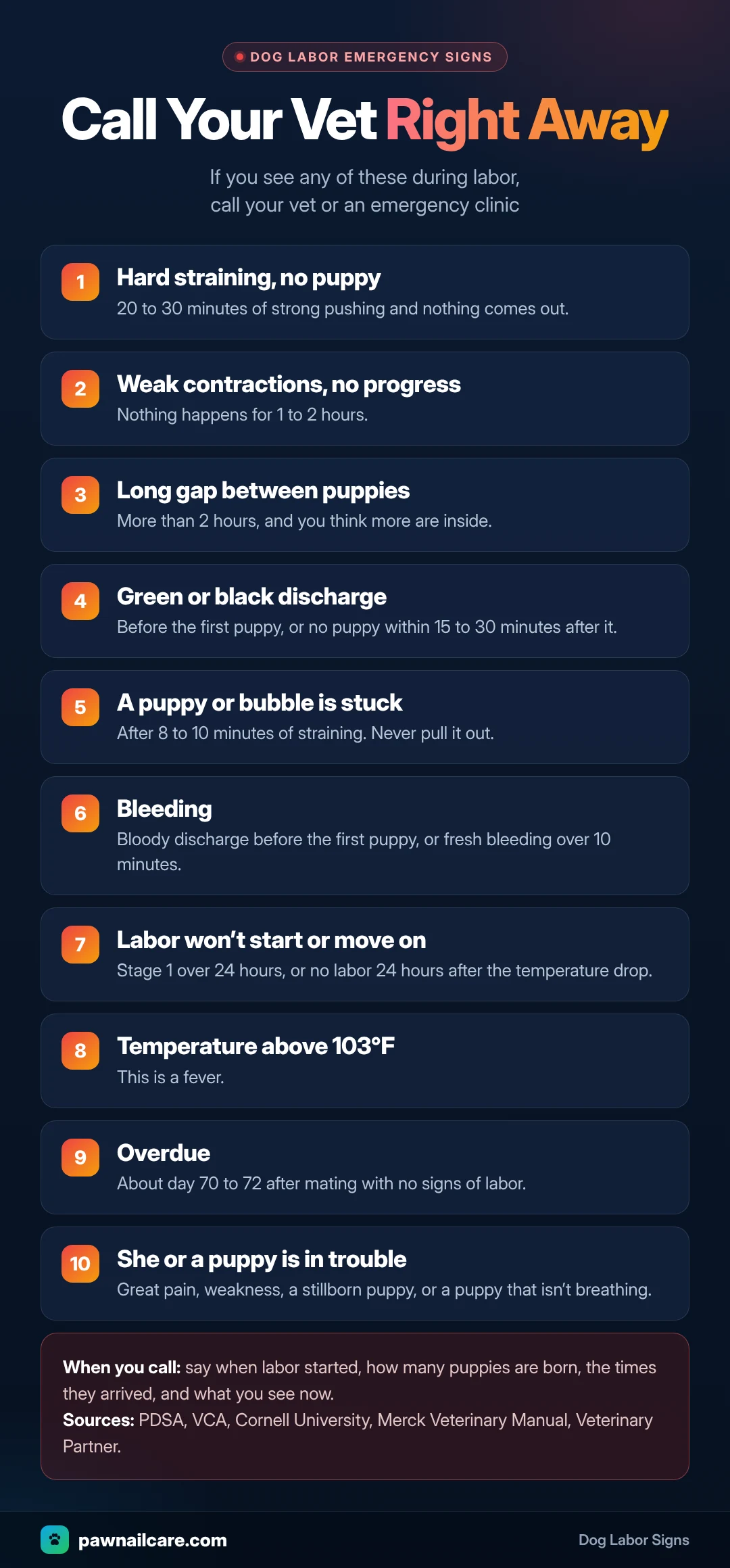
Call your vet or an emergency clinic if you see any of these signs:
- She strains hard for 20 to 30 minutes and no puppy comes (PDSA, VCA, Cornell).
- Her contractions are weak and nothing happens for 1 to 2 hours (Cornell).
- More than 2 hours pass between puppies and you think more are inside (Cornell).
- You see green or black discharge before the first puppy (Merck, VCA).
- You see green discharge and no puppy follows within 15 to 30 minutes (Cornell, Veterinary Partner).
- A puppy or fluid bubble is stuck at the vulva after 8 to 10 minutes of straining (VCA), or the membranes have been showing for more than 15 minutes (Cornell).
- There’s bloody discharge before the first puppy, more than a few drops of blood, or fresh bleeding that lasts over 10 minutes (VCA, PDSA).
- Stage 1 lasts more than 24 hours and she hasn’t started pushing (Merck).
- Her temperature dropped more than 24 hours ago and labor hasn’t started (VCA, Veterinary Partner).
- Her temperature goes above 103°F (VCA, Cornell).
- It’s been about 70 to 72 days since mating and there are no signs of labor (PDSA).
- She seems to be in a lot of pain, is weak or exhausted, or just isn’t herself (PDSA, Veterinary Partner, PetMD).
- A puppy is born dead, isn’t breathing, or makes a gurgling sound when it breathes (PDSA, VCA).
When you call, tell your vet when labor started, how many puppies have been born and at what times, and what you’re seeing now. This helps them decide how quickly she needs to be seen.
Labor Has Stopped or She Isn’t Pushing
Sometimes labor slows down or stops. The most common cause is uterine inertia, which means the uterus is too weak or tired to push the puppies out (Cornell). It can happen with very large litters, low calcium or blood sugar, illness or exhaustion.
Don’t try to restart labor yourself. Medicines such as oxytocin or calcium can help in some cases, but only your vet should decide that after examining her. Cornell explains that these medicines are only an option when nothing is blocking the birth canal, and PDSA notes they aren’t always right for every dog.
A Puppy Looks Stuck
If you can see part of a puppy and it isn’t moving out, call your vet right away. PDSA warns not to touch or try to pull out the puppy unless your vet tells you exactly what to do.
Dogs With a Higher Risk of Birth Problems
According to Cornell, some dogs are more likely to need help:
- Flat-faced breeds such as Bulldogs, Pugs and Boston Terriers. Cornell says more than half of their births may need a vet’s help.
- Small breeds such as Chihuahuas and Yorkshire Terriers.
- Dogs carrying a large litter of more than 8 puppies.
- Older dogs, and dogs that are overweight or underweight.
If your dog is in one of these groups, make a plan with your vet well before her due date. Cornell notes that a C-section is often advised for high-risk breeds.
How to Help Your Dog During Labor
Most of your job is to get things ready, stay calm and watch closely. Here’s what helps, and what to avoid.
Get Ready Before Her Due Date
- Set up a whelping box. It should let her stretch out and turn around, with sides low enough for her to step over but high enough to keep the puppies in. Rails along the inside walls help stop puppies from getting squashed (PDSA).
- Pick a quiet, warm room. PDSA suggests a secluded room kept at about 72°F (22°C).
- Let her get used to the box. The American Kennel Club advises introducing her to it at least 5 days before her due date.
- Save your vet’s numbers. Keep both the daytime and the after-hours emergency numbers in your phone (PDSA).
- Ask about an x-ray. An x-ray in late pregnancy shows how many puppies to expect, so you’ll know when she’s done (Veterinary Partner, AKC).
Supplies to have ready (from VCA):
- Plenty of clean towels and blankets
- Newspaper or washable bedding
- A plastic sheet to protect the floor
- A thermometer
- A bulb syringe to clear fluid from a puppy’s mouth and nose
- Clean scissors and clean thread for the cords
- A small box with a towel-wrapped warm (not hot) water bottle to keep the puppies warm
What to Do While She’s in Labor
- Watch quietly. PDSA advises keeping an eye on her and only stepping in if it’s really needed.
- Keep water close. She may not want it, but it should be there for her (Veterinary Partner).
- Write things down. Note the time labor started, when each puppy and placenta came out, and anything that worries you. These notes help a lot if you need to call your vet.
- Keep other dogs away. Veterinary Partner advises keeping her apart from other dogs.
- Keep your phone close with your vet’s numbers ready.
What Not to Do
- Don’t pull on a puppy that looks stuck. Call your vet instead (PDSA).
- Don’t give oxytocin, calcium or any other medicine unless your vet tells you to (AKC, Cornell, VCA).
- Don’t try to bring on labor at home.
- Don’t keep checking inside her. PDSA advises against examining her yourself.
- Don’t wait and hope if you see any of the warning signs above.
Right After Each Puppy Is Born
Most mothers take care of their newborns on their own. She will usually clear the sac and chew through the cord herself. Only step in if she doesn’t.
- Open the sac. Most sacs break during birth. If a puppy is still inside its sac, tear it open with your fingers as quickly as you can, starting near the head (VCA, PDSA).
- Clear the mouth and nose. Wipe the face and use a bulb syringe to clear any fluid (VCA).
- Rub the puppy dry. Rub gently with a clean towel. This helps the puppy breathe and keeps it warm (AKC, Veterinary Partner).
- Leave the cord to her if you can. The mother usually chews it about an inch from the puppy. If a cord is still attached after a few hours or keeps bleeding, call your vet and ask how to tie and cut it (VCA, PDSA).
- Keep the puppies warm. Newborn puppies can’t make enough body heat on their own. The AKC suggests keeping the whelping box at about 85°F.
Call your vet right away if a puppy isn’t breathing, isn’t moving, or has a raspy or gurgling breath after birth (PDSA, VCA).
Keep a close eye on the puppies for the first 3 days. The AKC advises calling your vet if a puppy isn’t nursing well, cries a lot, moves less than its littermates, or keeps ending up away from its mother.
How to Know Your Dog Is Done Giving Birth
The surest way is to know how many puppies to expect. An x-ray from about day 45 of pregnancy can show how many puppies she’s carrying (Veterinary Partner, PetMD). Once that many puppies, and the same number of placentas, have arrived, she’s most likely done.
Without an x-ray, it’s harder to be sure. After the last puppy, most mothers are tired and hungry and want to rest and feed their puppies (PDSA). But a mother can also rest quietly between puppies, so a calm dog isn’t proof that she has finished.
Call your vet if more than 2 hours have passed since the last puppy and you think more are inside (Cornell), if she strains again with no puppy, or if you simply aren’t sure. Cornell advises getting help right away whenever you’re unsure that labor is going normally. Your vet can check her and confirm that no puppies are left.
After Labor: What’s Normal and What’s Not
The days after birth bring a few changes. Some are normal, even if they look worrying. Others need a vet.
- Discharge (lochia): a green, red or brown discharge after birth is normal. It usually lasts about 3 weeks and can last up to 8 weeks, slowly getting darker and lighter in amount (Cornell, Veterinary Partner). It should never smell bad, and it shouldn’t increase.
- A mild fever: a small rise in temperature in the first 24 to 48 hours can be normal (Veterinary Partner).
- Signs of a womb infection (metritis): low energy, eating less, a high temperature, smelly discharge or less milk. Call your vet right away (PDSA).
- Her mammary glands: check them every day. Call your vet if they look red or swollen, seem painful, or if she has little milk or the milk looks an unusual color (PDSA).
- Eclampsia (milk fever): a dangerous drop in blood calcium, most common when the puppies are 1 to 4 weeks old and in small breeds. Early signs are restlessness, panting and stiff walking. It can lead to muscle spasms and seizures. It’s an emergency, so keep the puppies from nursing and call your vet (VCA: Eclampsia in Dogs).
VCA also notes that calcium supplements and dairy are generally not recommended for pregnant or nursing dogs, because too much calcium can raise the risk of eclampsia. Only give calcium if your vet advises it.
If This Is Your Dog’s First Litter
A first-time mother goes through the same stages of labor, but a few things can be different.
- Stage 1 may take longer. PDSA says the getting-ready stage can last up to 36 hours, especially in a first-time or nervous mother.
- She may need help with the sacs. PDSA notes that first-time mothers in particular may struggle to open the sac. Be ready to open it and clear the puppy’s face.
- She may feel unsure. If a first-time mother seems overwhelmed, the AKC suggests laying her on her side and placing the puppies on her nipples for the first few days.
- Plan ahead with your vet. A check-up and an x-ray in late pregnancy tell you how many puppies to expect.
The warning signs are the same for every dog, so keep the vet checklist above close at hand.
Dog Labor FAQs
Can You Induce Labor in a Dog at Home?
No. There’s no safe way to start labor at home. Medicines that strengthen contractions, such as oxytocin, should only be given by a vet after an exam, and the AKC notes they can cause a lack of oxygen if used the wrong way. If you think she’s overdue, check her due window with our Dog Pregnancy Calculator and call your vet.
Does a Dog’s Water Break?
Yes, in a way. Each puppy is born in its own fluid sac. Just before a puppy arrives, you may see a clear or white sac at the vulva, and a puppy should follow very soon (Cornell). If a bubble is stuck and she has strained for 8 to 10 minutes with no puppy, call your vet (VCA).
Is Green Discharge Normal During Labor?
It depends on the timing. Green discharge shows that a placenta is coming away (Cornell). Before the first puppy, it isn’t normal, so call your vet right away (Merck, VCA). Between puppies it can be normal, but a puppy should follow within 15 to 30 minutes (Cornell).
Can My Dog Eat or Drink During Labor?
Many dogs refuse food, and sometimes water, once labor is close (Dogster). Don’t force her. Just keep fresh water nearby (Veterinary Partner). After the birth she’ll be hungry, so have her food ready (PDSA).
Should I Leave My Dog Alone While She Gives Birth?
No. Stay close and watch, but give her space. PDSA advises keeping an eye on her and stepping in only when it’s really needed. That way you can spot a problem early.
Do Dogs Feel Pain or Cry During Labor?
Labor is hard work, and some dogs whine or yelp during contractions (Dogster). That alone isn’t a worry. But if she seems to be in a lot of pain, cries nonstop, or becomes weak or unresponsive, call your vet (Veterinary Partner, PetMD, PDSA).
Is Shaking or Heavy Panting Normal Before Labor?
Yes. Panting, shivering and trembling are common in stage 1 (Cornell, Veterinary Partner), and they usually come with other signs such as nesting and a temperature drop. Shaking in the weeks after birth is different. Restlessness, panting, stiffness or muscle spasms while she’s nursing can mean eclampsia, which is an emergency (VCA).
Can a Dog Go Into Labor Early?
A little. Counted from the first breeding, a normal pregnancy can last 58 to 72 days, according to the Merck Veterinary Manual, so the due date is only a guide. Our Dog Pregnancy Calculator shows her likely window. If labor signs start well before that window, or she reaches about day 70 to 72 with no signs, call your vet (PDSA).
How Many Placentas Does a Dog Have?
One for each puppy. A placenta usually comes out about 15 minutes after each puppy, but sometimes two puppies come first and then two placentas (PDSA, Cornell). Count them if you can.
Sources
- Merck Veterinary Manual: Labor, Delivery, and Postpartum Care in Bitches and Queens (Autumn P. Davidson, DVM, DACVIM)
- Merck Veterinary Manual: Whelping and Queening in Dogs and Cats
- Cornell University, Riney Canine Health Center: The Normal Whelping Process
- Cornell University, Riney Canine Health Center: Dystocia in Dogs, Understanding Difficult Births
- PDSA: Whelping, a Guide to Your Dog Giving Birth
- VCA Animal Hospitals: Breeding for Pet Owners, Whelping in Dogs (Barnes, Weir, Ward)
- VCA Animal Hospitals: Breeding for Dog Owners, Problems at Birth (Barnes, Weir, Ward)
- VCA Animal Hospitals: Eclampsia in Dogs (Weir, Williams, Llera, Ward)
- PetMD: Whelping, a Guide to Help Your Dog Through Labor (Melissa Boldan, DVM)
- Veterinary Partner (VIN): Pregnancy and Whelping in Dogs
- American Kennel Club: Best Practices for Whelping and Caring for Newborn Puppies
- Dogster: Signs a Dog Is Going Into Labor Soon (reviewed by Athena Gaffud, DVM)
Please note: this guide is for general information. It can’t replace your veterinarian. Always talk to your vet about your dog’s pregnancy, labor and the care of her puppies.