
Puppy Weight Calculator: How Big Will My Puppy Get?
Want to know how big your puppy will get? Enter your puppy’s age, weight, sex and breed size below. The calculator estimates your puppy’s adult weight and draws a growth chart just for them.
It’s built on the WALTHAM puppy growth charts, which were made from the weight records of nearly 50,000 healthy dogs. So instead of a one-size-fits-all formula, your estimate comes from how real puppies of the same size actually grew.
Your vet’s records are a great place to find your puppy’s weight. You can also weigh your puppy at home, and we show you how further down.
How big will my puppy get?
Estimate your puppy’s adult weight and see a growth chart, based on the WALTHAM puppy growth charts built from data on nearly 50,000 dogs.
How to Use This Puppy Weight Calculator
- Choose lb or kg at the top of the calculator.
- Pick your puppy’s sex. Male and female puppies have separate charts, because females usually end up lighter.
- Choose the breed size. Pick your breed’s typical adult weight. If you know the adult weights of the parents, use those. Not sure, or have a mixed breed? Choose “Not sure / mixed breed.”
- Enter your puppy’s age and weight. Age can be in weeks or months. The charts start at 12 weeks, which is about 3 months.
Have an older weight from a vet visit? Add it under “Add an earlier weight.” The calculator then checks whether your puppy is growing along the same line, which is what healthy growth looks like on these charts.
How the Calculator Works
The calculator uses the WALTHAM Puppy Growth Charts. They come from a 2017 study in the journal PLOS ONE that used the vet records of puppies seen at Banfield Pet Hospitals, mostly in the US.
The researchers only included healthy dogs in ideal body condition. The final size charts were built from about 49,700 dogs.
Each chart has nine curved lines called centiles. The 50th centile is the middle line, where half of the puppies in the study were heavier and half were lighter.
Here’s what the calculator does with your numbers:
- It picks the chart for your puppy’s sex and breed size.
- It works out which centile line your puppy is on right now.
- It follows that line to the end of the chart to estimate your puppy’s adult weight.
This works because healthy puppies tend to stay on the same line as they grow. The WALTHAM charts say growth is normal as long as a puppy keeps tracking along the same centile line, or between the same two lines.
The original study covered dogs up to 40 kg (88 lb). WALTHAM now also has Giant and Giant Plus charts for bigger breeds, and the calculator uses those too.
A few limits to keep in mind: the charts start at 12 weeks, so the calculator can’t estimate younger puppies. It also can’t see illness, diet problems or a breed mix it doesn’t know about. Treat the result as a helpful estimate, not a promise.
Puppy Weight Chart by Size
Here’s what a typical puppy weighs at each age, by size. These are the median (50th centile) weights from the WALTHAM charts, in pounds (lb).
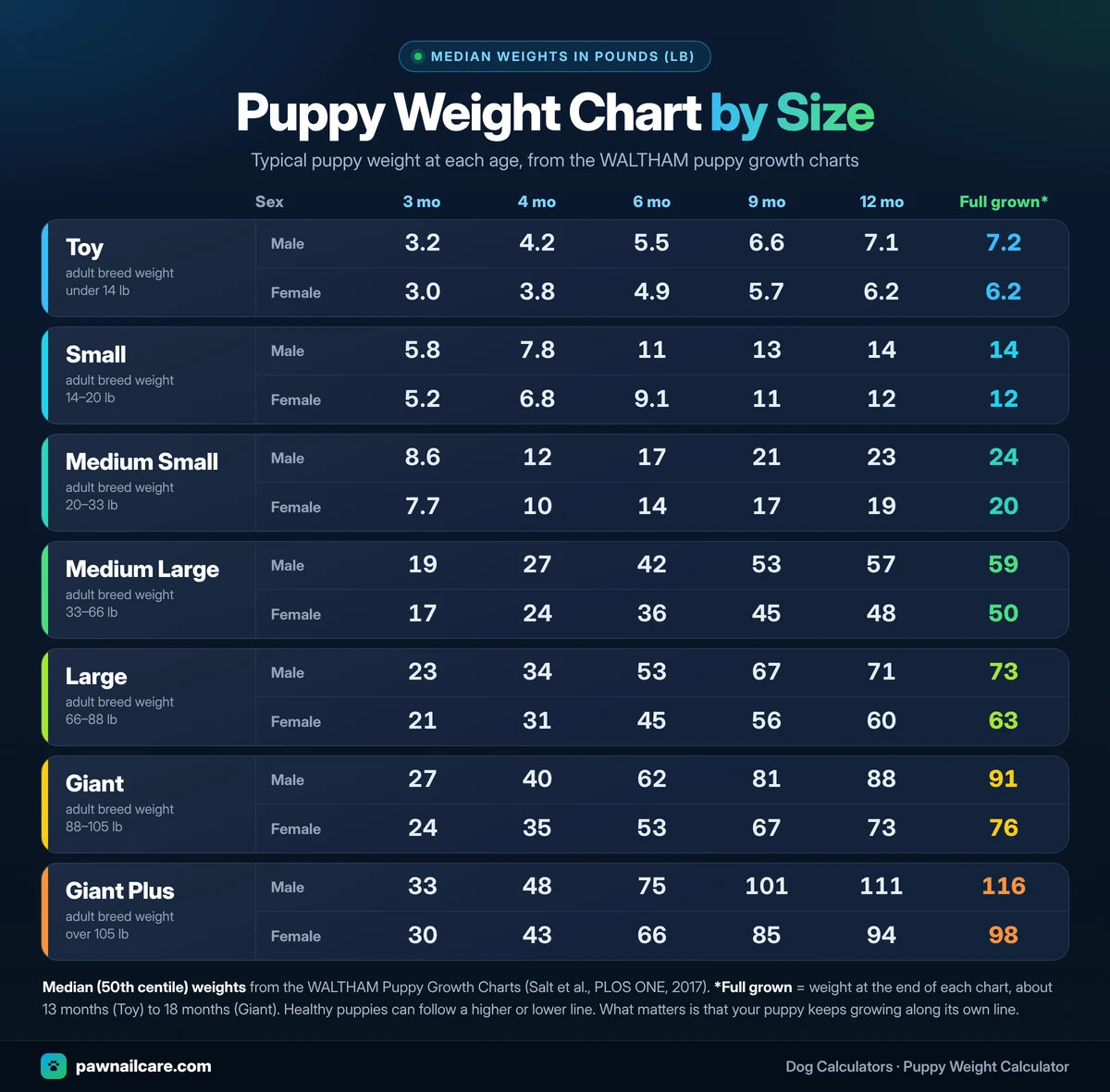
| Size and sex | 3 mo | 6 mo | 12 mo | Full grown |
|---|---|---|---|---|
| Toy male | 3.2 | 5.5 | 7.1 | 7.2 |
| Toy female | 3.0 | 4.9 | 6.2 | 6.2 |
| Small male | 5.8 | 11 | 14 | 14 |
| Small female | 5.2 | 9.1 | 12 | 12 |
| Medium Small male | 8.6 | 17 | 23 | 24 |
| Medium Small female | 7.7 | 14 | 19 | 20 |
| Medium Large male | 19 | 42 | 57 | 59 |
| Medium Large female | 17 | 36 | 48 | 50 |
| Large male | 23 | 53 | 71 | 73 |
| Large female | 21 | 45 | 60 | 63 |
| Giant male | 27 | 62 | 88 | 91 |
| Giant female | 24 | 53 | 73 | 76 |
| Giant Plus male | 33 | 75 | 111 | 116 |
| Giant Plus female | 30 | 66 | 94 | 98 |
Full grown means the weight at the end of each chart. That’s about 13 months for Toy breeds and about 18 months for Giant breeds.
Don’t worry if your puppy doesn’t match these numbers. The middle line isn’t a target. Plenty of healthy puppies sit above or below it. What matters is that your puppy keeps following its own line.
Why Simple Puppy Weight Formulas Often Overestimate
Many puppy weight calculators use one simple formula: divide the puppy’s weight by its age in weeks, then multiply by 52.
The problem is that puppies don’t grow at a steady rate. They grow fastest when they’re young, then slow down. In a WALTHAM study of 12 breeds, most puppies gained about 13 to 17 percent of their body weight per week early on, before their growth slowed.
So the simple formula tends to guess too high. Here’s how it compares with the WALTHAM charts for four typical puppies:
| Puppy | Weight now | Simple formula | WALTHAM chart | Difference |
|---|---|---|---|---|
| Toy male, 12 weeks | 2.9 lb | 12.8 lb | 7.2 lb | +78% |
| Medium Small male, 16 weeks | 10.9 lb | 35.5 lb | 23.7 lb | +50% |
| Large male, 16 weeks | 31.1 lb | 100.9 lb | 73.0 lb | +38% |
| Giant Plus male, 26 weeks | 74.8 lb | 149.5 lb | 116.4 lb | +28% |
Each puppy in this table sits exactly on the middle line for its size. If it keeps growing normally, it ends up at the WALTHAM weight. The simple formula guesses 28 to 78 percent too high for these puppies.
Dog Size Chart by Adult Weight
The WALTHAM charts group dogs by their breed’s typical adult weight. These are the seven size groups the calculator uses:
| Size group | Adult breed weight (lb) | Adult breed weight (kg) |
|---|---|---|
| Toy | Under 14.3 lb | Under 6.5 kg |
| Small | 14.3 to 19.8 lb | 6.5 to 9 kg |
| Medium Small | 19.8 to 33.1 lb | 9 to 15 kg |
| Medium Large | 33.1 to 66.1 lb | 15 to 30 kg |
| Large | 66.1 to 88.2 lb | 30 to 40 kg |
| Giant | 88.2 to 104.7 lb | 40 to 47.5 kg |
| Giant Plus | Over 104.7 lb | Over 47.5 kg |
These groups are a little different from the “toy, small, medium and large” labels you’ll see elsewhere. Kennel clubs and websites don’t all use the same cut-offs, so always go by the weight range, not just the name.
When Do Puppies Stop Growing?
Small dogs finish growing much sooner than big dogs. In the WALTHAM study of 12 breeds, toy, small and medium breeds reached 99 percent of their adult weight at about 9 to 10 months. Large and giant breeds took about 11 to 15 months.
The American Kennel Club gives a similar picture. Small breeds typically stop growing by 6 to 8 months, and medium breeds reach their adult size at around 12 months.
Large and giant breeds grow until they’re 12 to 18 months old, according to AKC Chief Veterinarian Dr. Jerry Klein, and very large breeds like Mastiffs may not reach full size until 24 months.
The growth charts show the same pattern in weight:
- At 6 months, a typical puppy has reached about 64 to 78 percent of its adult weight. Bigger breeds are at the lower end.
- At 12 months, a typical puppy is at about 95 to 99 percent of its adult weight.
Even after the bones stop growing, puppies keep filling out with muscle and body fat, the AKC notes.
How Much Weight Should a Puppy Gain Per Week?
Puppies gain weight fastest in their first few months. Here’s the median weekly gain between 12 and 16 weeks of age, from the WALTHAM charts:
| Size group | Male, per week | Female, per week |
|---|---|---|
| Toy | 3.7 oz | 3.2 oz |
| Small | 8.2 oz | 6.2 oz |
| Medium Small | 13 oz | 10 oz |
| Medium Large | 2.0 lb | 1.7 lb |
| Large | 2.6 lb | 2.3 lb |
| Giant | 3.0 lb | 2.6 lb |
| Giant Plus | 3.5 lb | 3.0 lb |
By 6 months, growth slows down. For example, a typical Large male puppy gains about 1.7 lb a week between 24 and 28 weeks, compared with about 2.6 lb a week at 12 to 16 weeks.
Your puppy’s own number depends on where it sits on the chart. The calculator shows the expected weekly gain for your puppy over the next four weeks.
How to Weigh Your Puppy at Home
Royal Canin’s veterinary guide suggests weighing puppies at least every two weeks, and ideally every week. Here’s an easy way to do it:
- Use a bathroom scale. Weigh yourself, then weigh yourself holding your puppy. The difference is your puppy’s weight.
- Or use a luggage scale. Hang your puppy in a carrier or bag, then subtract the weight of the empty carrier. A pet scale works well too.
- Weigh at the same time of day. Meals, drinking and bathroom breaks all change the number on the scale.
- Write it down with the date. Next time, you can add it to the calculator as an earlier weight for a growth check.
Mixed Breed Puppies: How to Estimate Adult Size
Mixed breed puppies are the hardest to predict. AKC Chief Veterinarian Dr. Jerry Klein calls it “a bit of a guessing game,” especially between 6 and 10 weeks of age.
These steps help:
- Use the parents’ weights if you know them. Royal Canin’s guide suggests using the parents’ adult weights to pick a growth chart, as long as the parents were a healthy weight.
- Weigh your puppy every week or two. A few weights over time show which line your puppy is really following.
- Think about a DNA test. Royal Canin lists genetic testing as another way to estimate adult size.
- Use the “Not sure / mixed breed” option. The calculator checks every chart and picks the one where your puppy sits closest to the middle line. If other charts fit too, it shows you a likely range.
When to Talk to Your Vet
The WALTHAM charts list these as possible signs of a growth problem:
- Moving up across several centile lines. Growing much faster than before can mean a puppy is at risk of becoming overweight.
- Dropping down across several centile lines. Slowing down like this can be a sign that a puppy isn’t thriving.
- A flat line. If your puppy stops gaining weight before reaching adult size, it’s time for a check-up.
Royal Canin’s guide adds that dogs who became obese by age three had often crossed two or more centile lines as puppies.
Your vet can also check your puppy’s body condition. That tells you more than weight alone.
Frequently Asked Questions
How accurate is a puppy weight calculator?
No calculator can predict an exact adult weight. This one is based on growth data from about 49,700 healthy dogs, and healthy puppies usually keep following the same line. But illness, diet and genetics can change the path. Weigh your puppy regularly and run the calculator again to see if the estimate stays steady.
Can paw size tell how big a puppy will get?
Not reliably. Paws that look big for the body can mean a puppy has more growing to do, but a vet-written guide from Dutch calls paw size “not definitive.” Your puppy’s age, weight and breed size are a better guide.
Does neutering change how a puppy grows?
A little. In the WALTHAM study, neutering before about 37 weeks was linked with a small upward shift in weight, and neutering after 37 weeks with a small downward shift. The effect was small enough that separate charts for neutered dogs weren’t needed.
My puppy is under 12 weeks. Can I still use the calculator?
Not yet. The WALTHAM charts start at 12 weeks, so there isn’t reliable data for younger puppies. Weigh your puppy once a week and come back when they reach 12 weeks (about 3 months).
How much will my puppy grow after 6 months?
Quite a bit. At 6 months, a typical puppy is at about 64 to 78 percent of its adult weight, so roughly a quarter to a third of the growing is still to come. Giant breeds have the most left.
Are male puppies bigger than female puppies?
Usually, yes. In the WALTHAM charts, the median full-grown female is about 13 to 17 percent lighter than the male in the same size group. That’s why the calculator asks for your puppy’s sex.
More Free Dog Calculators
Puppy nails grow fast, and regular trims make handling easier as your puppy grows. Try our other free tools:
- Dog Nail Trim Schedule Calculator: find out how often to trim your dog’s nails.
- Dog Nail Length Checker: check whether your dog’s nails are too long.
- All Dog Calculators: see every free tool on Dog Nail Care.
Sources
- Salt C, et al. Growth standard charts for monitoring bodyweight in dogs of different sizes. PLOS ONE, 2017
- WALTHAM Petcare Science Institute: Puppy Growth Charts
- Hawthorne AJ, et al. Body-weight changes during growth in puppies of different breeds. Journal of Nutrition, 2004
- Royal Canin Academy: Puppy growth charts
- American Kennel Club: When Does My Puppy Finish Growing?
- Dutch: Puppy Weight Calculator (Kate Elden, DVM)