
How Long Should Dog Nails Be? Length Chart + Free Checker
By Mehwish · Updated October 22, 2026
Your dog’s nails grow a little every day, and it’s easy to miss the moment they get too long. So how long should dog nails be? The short answer is simple: when your dog stands still on a hard floor, healthy nails should not touch the ground.
That one check tells you more than any number on a ruler. Below, you’ll find our free checker, a dog nail length chart, and the simple tests veterinarians use to judge the proper dog nail length at home.
Are Your Dog’s Nails Too Long?
Two quick checks and a few simple questions. Get a clear result for your dog in under a minute.
How this checker works and sources
This tool uses two simple checks described by veterinary professionals, plus common signs of overgrown nails.
- Floor test: at the right length, nails do not touch the ground while your dog stands still. They only touch when your dog walks.
- Pad line test: picture a line running forward from the bottom of the paw pad. A nail tip that crosses below this line is too long.
- Clicking: counts only a little, because some dogs click on hard floors even when their nails are a healthy length.
- Feet and walking: spread toes, flat-looking feet, slipping or a change in walking can be signs of long nails.
- Red flags: nails or dewclaws growing into the skin, injuries or signs of infection get a vet referral instead of a home plan.
The result is a general guide, not a diagnosis. We do not list exact lengths in millimeters for each breed, because no veterinary source gives reliable numbers like that. Your dog’s own paw is the best measure.
Sources: Walkerville Vet (Dr Andrew Spanner, BVSc) · Whole Dog Journal (Kate Basedow, LVT) · VCA Animal Hospitals · American Kennel Club
Answer a few questions about your dog’s nails, feet and walk, and the checker shows where your dog falls on the chart below. It also flags signs that need a vet visit instead of a trim.
Table of Contents
How Long Should Dog Nails Be?
Healthy nails sit just above the floor when your dog stands still. Veterinarian Dr Andrew Spanner explains that each nail generally hovers about 1 mm above the surface and only touches the ground when your dog moves.
VCA Animal Hospitals gives the same rule in plain terms. If your dog’s nails touch the floor while standing, they are too long and should be trimmed. As Whole Dog Journal puts it, the correct dog nail length is short.
There is a second check you can use as well. Picture a line running forward from the bottom of the paw pad. According to Dr Spanner, the nail should not cross this line.
Why There’s No Exact Length in Millimeters
You may see charts online that list nail lengths by breed. We don’t, because we could not find a veterinary source that gives reliable numbers like that. The right length depends on the size and shape of each dog’s paw.
The floor test works for every dog, from a Chihuahua to a Great Dane. Your dog’s own paw is the best measuring tool you have.
Dog Nail Length Chart
Use this chart to compare your dog’s nails while your dog stands on a hard, flat floor.
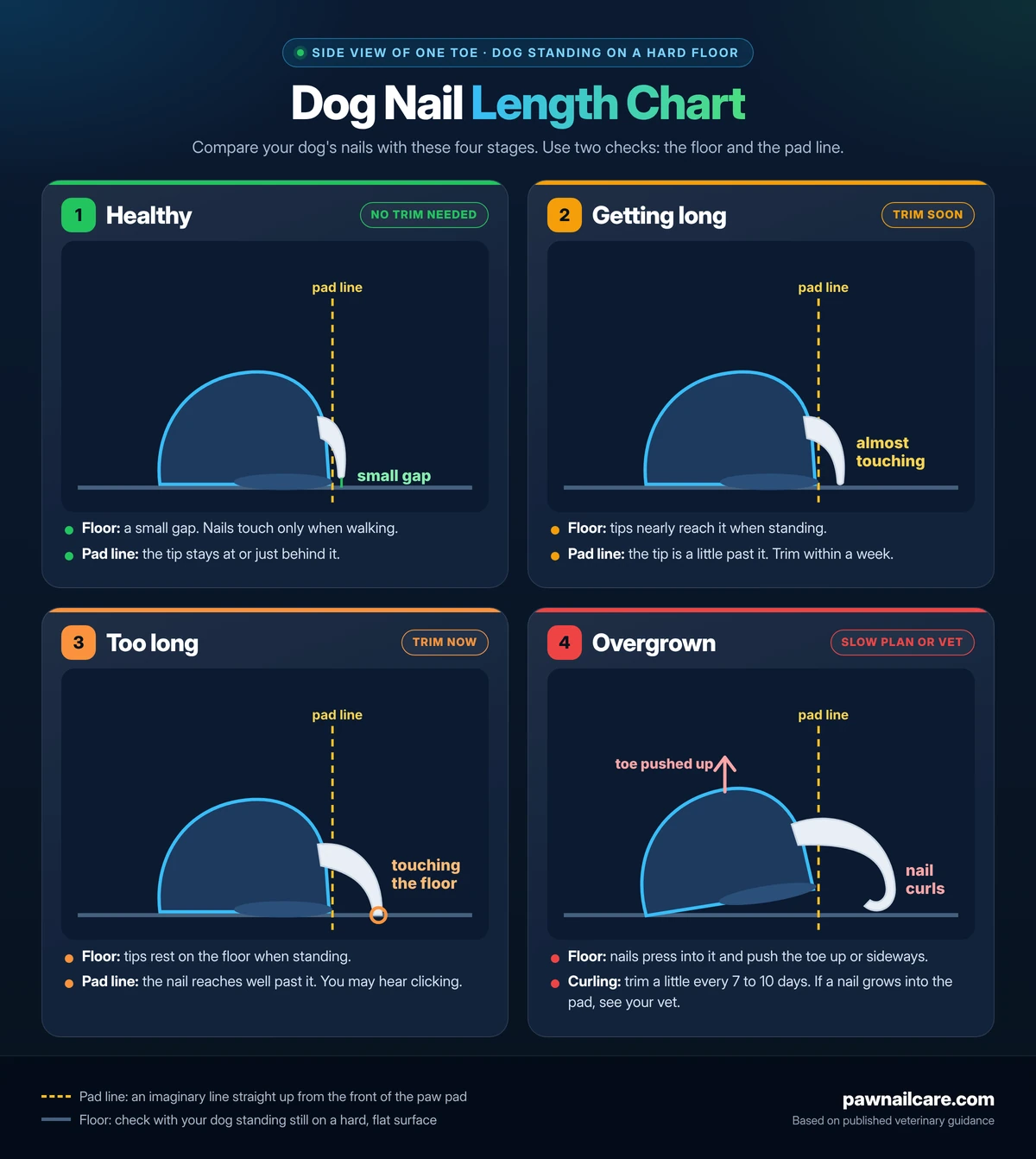
- Healthy: there’s a small gap between the nail and the floor. Nails touch the ground only when your dog walks.
- Getting long: the tips nearly reach the floor. Trim just the tips within a week.
- Too long: the tips rest on the floor when your dog stands. You may also notice clicking, slipping or snagging.
- Overgrown: the nails press into the floor, push the toes up or sideways, and start to curl. These need a slow trimming plan, and a vet visit if a nail grows into the pad.
Aim to trim before your dog’s nails reach stage three. Small, regular trims keep them in the healthy range.
How to Check Your Dog’s Nail Length at Home
Both checks take less than a minute, and you don’t need any tools.
The Floor Test
- Pick a hard, flat floor. Tile, wood or laminate makes the gap easy to see. Carpet hides it.
- Let your dog stand naturally. Wait until your dog is relaxed and standing square, not leaning or walking.
- Look from the side at paw level. Check each foot, front and back.
- Look for a small gap. If the tips rest on the floor, it’s time for a trim.
The Pad Line Test
This check is handy when your dog is lying down or won’t stand still. Gently hold the paw, or look at it from the side.
Picture a line running forward from the bottom of the paw pad, the part that touches the ground. Dr Spanner advises that the nail should not cross this line. If the tip dips below it, the nail is too long.
Checking Long-Haired Dogs
Long fur can hide the nails completely. Veterinarian Dr Shelby Neely, writing for Adoptapet, notes that nails are harder to see on long-haired dogs.
Gently part the fur around each toe so you can see the tips. You can also run a finger along the underside of the paw. If you feel nail tips sitting lower than the pads, the nails are too long.
Don’t Forget the Dewclaws
Dewclaws are the small nails on the inner side of the leg. They never touch the ground, so they never wear down, and VCA notes that they often become overgrown.
Dr Spanner suggests trimming a dewclaw when it catches on your finger, and only back until it no longer catches. If a dewclaw has curled back into the skin, see your vet.
Dog Nails Too Long? 8 Signs to Look For
Beyond the floor test, your dog may show you that the nails need attention. Watch for these signs:
- Nails touch the floor when your dog stands still.
- Nails curve toward the paw pads. Whole Dog Journal warns that nails curling back can grow into the pad.
- Toes look spread out or the feet look flat. Whole Dog Journal lists splayed, flat-looking feet as a common sign.
- Slipping on smooth floors. The AKC notes that long nails reduce traction.
- Tip-toeing, walking gingerly or limping.
- Nails snag on blankets, carpet or clothing.
- You get scratched when your dog paws at you.
- Licking the paws more than usual. This can point to discomfort, though paw licking has many possible causes.
Veterinarian Dr Tierra Price, writing for Great Pet Care, explains that long nails create an unnatural angle for the foot. This puts uneven pressure on the toes and can make the nail beds sore.
Is Nail Clicking Always a Sign of Long Nails?
Not always. Clicking on hard floors is one of the most common reasons owners check their dog’s nails, and it’s often a good hint.
However, Dr Spanner points out that some dogs click even when their nails are a healthy length. He calls nail noise an unreliable test until you know what’s normal for your own dog.
So treat clicking as a reason to look, not as the final answer. The floor test and the pad line test tell you more.
What Happens If Dog Nails Get Too Long?
Long nails are more than a cosmetic problem. They change how the foot meets the ground, and they can lead to painful injuries.
Snags, Splits and Breaks
A long nail works like a hook. It can catch on carpet, deck boards or blankets and tear. Great Pet Care also notes that long nails are more prone to splitting.
These are common causes of a dog nail torn halfway, a dog nail split vertically or a dog broken toenail at the base.
Nails Growing Into the Pad
If nails keep growing, they can curl around and dig into the paw pad or skin. This is painful and can lead to infection.
If you see redness, swelling or pus around a nail, our guide to dog nail infection treatment explains the next steps.
Posture, Walking and Older Dogs
Many veterinarians say that long nails can change how a dog stands and walks. Preventive Vet explains that this change in gait and posture can cause pain and inflammation in the joints.
Older dogs may feel it most. Dr Julie Buzby, a veterinarian who focuses on senior dog mobility, says that long toenails, especially over a lifetime, negatively alter posture and gait and set dogs up for injury.
What the Latest Research Says
Not every study agrees on how much nail length affects walking. A small 2026 study in Frontiers in Veterinary Science looked at seven healthy dogs on a pressure-sensing treadmill before and after a nail trim.
The researchers found no significant change in the main gait measurements right after trimming. They suggested that long nails may sometimes be the result of reduced natural wear, rather than the cause of a walking problem.
The study was small, and it only looked at the immediate effect of one trim. It doesn’t mean nail trims don’t matter. Long nails still raise the risk of tears, breaks and nails growing into the pad.
How to Bring Overgrown Nails Back to a Healthy Length
Inside each nail is the quick, the living core with blood vessels and nerves. When nails grow long, the quick grows with them, so you can’t cut overgrown nails short in one go.
The good news is that the quick can move back. The AKC explains that regular trimming causes the quick to recede from the end of the nail.
- Trim a small amount every 7 to 10 days. Preventive Vet suggests trimming weekly, or at least every other week, when it’s practical.
- Take off only the tip each time. Stop well before the quick.
- Repeat until the nails pass the floor test. This can take weeks or even months.
- Then switch to a regular schedule that fits your dog’s lifestyle.
Some links in this guide may be affiliate links. This does not affect our content or recommendations.
If the nails are very long or your dog won’t let you near them, VCA recommends having a veterinarian or groomer do the first trim. A dog nail grinder can also help, because it removes a little at a time.
Our trim schedule calculator has a recede mode that tells you when each small trim is due.
How Often Should You Check Your Dog’s Nails?
Dr Neely recommends checking your dog’s nails every two weeks, whatever your trimming schedule. A quick floor test is all it takes.
How often you trim depends on age, activity and the surfaces your dog walks on. For a personal answer, find out how often to trim your dog’s nails with our free calculator.
Have a new puppy? Use our puppy weight calculator to see how big your puppy is likely to get.
When to See Your Vet
Some nail problems need professional care. Contact your veterinarian if you notice:
- A nail or dewclaw curling into the paw pad or skin
- A broken, split or torn nail
- Bleeding that doesn’t stop after several minutes
- Swelling, redness, pus or a bad smell around a nail
- Limping or holding a paw up
- A dog so stressed that trimming at home isn’t safe
For very anxious dogs, VCA notes that your veterinarian may be able to prescribe a mild sedative for nail trims. If a nail is bleeding, our guide on a dog nail that keeps bleeding covers what to do first.
Frequently Asked Questions
Should a dog’s nails touch the ground?
No. When your dog stands still on a hard, flat floor, healthy nails should sit just above the ground and touch it only when your dog walks.
How do I know if my dog’s nails are too long?
The easiest sign is nails touching the floor while your dog stands. Other signs include nails curving toward the pads, splayed toes, slipping, snagging on fabric and limping. The checker above can help you decide.
Can long nails make a dog limp?
Yes, they can. Long nails can be painful, especially when they press into the floor or curl toward the pad. Limping can also have other causes, so if it doesn’t improve after a trim, see your vet.
Is there a dog nail length chart by breed?
Some websites show nail lengths by breed, but we couldn’t find a veterinary source that supports exact numbers like that. Use the floor test and the pad line test instead. They work for every breed and size.
How short should I cut overgrown nails?
Not short in one session. Trim only the tip every 7 to 10 days so the quick can recede. On light nails, VCA advises staying about 2 to 3 mm away from the pink quick.
Final Veterinary Advice for Dog Owners
You don’t need a ruler to know if your dog’s nails are the right length. If they touch the floor when your dog stands still, they’re too long.
Check every couple of weeks, trim a little at a time, and give overgrown nails the time they need to come back. Small, regular trims are kinder than one big cut.
If you see a nail growing into the skin, an injury or signs of infection, let your veterinarian take a look.
Sources
- Walkerville Vet: Do Dogs Need Their Nails Clipped? (Dr Andrew Spanner, BVSc)
- Whole Dog Journal: How Long Should a Dog’s Nails Be? (Kate Basedow, LVT)
- VCA Animal Hospitals: How to Trim a Dog’s Nails (Courtney Barnes, BSc, DVM; Catherine Barnette, DVM)
- Adoptapet: How Long Should Dog Nails Be? (Dr Shelby Neely, DVM)
- Great Pet Care: 7 Ways to Tell Your Dog’s Nails Are Too Long (Dr Tierra Price, DVM)
- Preventive Vet: How Often Should You Cut Your Dog’s Nails? (Dr Beth Turner)
- American Kennel Club: How to Trim Dog Nails
- Grey Muzzle: Improving Canine Mobility, an interview with Dr Julie Buzby, DVM
- Frontiers in Veterinary Science (2026): Trimming of nails in healthy dogs does not change gait parameters (Häusler K, Söhnel K)
Disclaimer: This article is for informational purposes only and describes general nail care guidance for dogs. It does not constitute specific medical advice for your individual pet. If your dog’s nails are injured, infected, or growing into the skin, please contact your veterinarian.