
Table of Contents
In my ten years of veterinary practice, I’ve lost count of how many times a worried owner has walked into my exam room, pointing nervously at their dog’s paw. Usually, the story starts the same way: “He won’t stop licking it,” or “She yelps when I try to wipe her paws after a walk.”
When we look closer, we often find a nail infection.
While a broken nail or a little redness might seem minor compared to major surgeries or systemic illnesses, I can tell you from experience that nail issues are disproportionately painful for our dogs. Think about how much a simple hangnail or an ingrown toenail hurts you. Now, imagine walking on that inflamed spot barefoot, over concrete, grass, and carpet, all day long.
The good news is that nail infections are generally very treatable, especially when caught early. But they are also complex. They aren’t always just “an infection”—they can be a symptom of allergies, an autoimmune issue, or simply bad luck on a hike.
In this comprehensive guide, I’m going to walk you through everything you need to know about dog nail health. My goal is to take the panic out of the situation and give you the knowledge you need to help your best friend feel better.
What Is a Dog Nail Infection?
To understand what’s going wrong, we first need a quick, simple lesson on paw anatomy. When I explain this to clients, I like to compare the dog’s claw to our fingers, but with a crucial difference in architecture.
A dog’s nail consists of two main parts:
- The Keratin Shell: This is the hard outer layer that you trim. It’s essentially dead tissue, much like your fingernails.
- The Quick (Ungual Process): This is the living, breathing center inside that shell. It contains blood vessels and nerve endings. It is attached to the bone of the toe.
Surrounding the base of the nail is the nail fold (or ungual fold), where the skin meets the claw.
A “nail infection” is rarely just the hard shell getting sick. In veterinary medicine, we often refer to this as Paronychia (inflammation of the soft tissue around the nail) or Onychomycosis (fungal infection of the nail substance itself).
When a dog develops an infection here, it means bacteria, fungus, or yeast has breached the protective barrier of the hard shell or the skin surrounding it. Once those invaders get into the soft, sensitive tissue of the nail bed or the nail fold, the body reacts with inflammation.
It’s important to distinguish between an infection of the nail versus the skin between the toes (interdigital dermatitis), though they often go hand-in-hand. A true nail infection centers on the claw itself and the cuticle area immediately surrounding it. The area becomes a pressure cooker of inflammation, and because the hard shell doesn’t allow for swelling, the pressure builds up inward, pressing on those sensitive nerves in the quick. That is why your dog is limping.
Common Causes of Dog Nail Infections
One of the most common questions I get is, “How did this happen?” Owners often feel guilty, assuming they did something wrong. But the truth is, paws are in constant contact with the world—the dirty, wet, rough world.
In my experience, infections rarely happen spontaneously. They are usually opportunistic, meaning the bacteria or fungus takes advantage of a weakness in the nail’s defense. Here are the primary culprits I see in the clinic.
Bacterial infections
Bacteria are everywhere—on your floor, in the soil, and even naturally living on your dog’s skin. A healthy dog’s immune system keeps these in check. However, if there is a tiny scrape, a crack in the nail, or chronic moisture, bacteria can invade.
The most common invader I see is Staphylococcus, followed closely by Streptococcus.
Consider a muddy day at the park. Your dog runs through a puddle, softening the skin around the nail. Then, they scramble up a rocky embankment, causing a microscopic tear in the cuticle. The bacteria from the mud enter that tear. Within 24 hours, the bacteria multiply in the warm, dark environment of the nail bed, leading to a painful, pus-filled infection.
I also see bacterial infections frequently in dogs who are obsessive lickers. The mouth is full of bacteria. If a dog licks a paw due to boredom or allergies, they are literally seeding the nail bed with bacteria while simultaneously keeping it wet—the perfect recipe for infection.
Fungal and yeast infections
While bacteria are common, fungal and yeast organisms are the persistent, nagging causes of nail issues that drive owners crazy because they just won’t seem to go away.
Ringworm (Dermatophytosis): Despite the name, this is a fungus, not a worm. It feeds on the keratin of the nail. This is less common in the nail than on the skin, but when it happens, it leaves the nails looking brittle, deformed, and crumbly.
Malassezia (Yeast): This is the big one. Malassezia pachydermatis is a yeast that lives naturally on your dog. But when the conditions are right—usually warm and humid—it overgrows.
I see this constantly in floppy-eared dogs and dogs with allergies. You’ll know it by the smell (more on that later) and the reddish-brown staining at the base of the nail. Yeast loves the “nook and cranny” space where the nail enters the toe. If your dog has allergies, their skin barrier is weaker, and yeast takes over, causing intense itching that leads to chewing, which leads to secondary bacterial infections. It’s a vicious cycle.
Nail trauma and cracks
This is the “mechanical” cause. Active dogs—the frisbee chasers, the hikers, the pavement runners—are prone to traumatic nail injuries.
If a nail gets too long, it changes the mechanics of the foot. Instead of the toe pads taking the impact, the nail hits the ground first. This jams the nail back into the nail bed with every step, causing inflammation.
Worse, a long nail is easily snagged on carpet, deck boards, or roots. This can cause the hard shell to crack or split vertically. A split nail is agonizingly painful because the crack often goes right down to the sensitive quick.
Once the nail is cracked, the seal is broken. The crack acts like a highway for germs to travel straight into the blood supply of the nail. Even if the crack itself doesn’t look “infected” initially, without treatment, the exposed quick will almost certainly become infected within a few days.
Poor Nail Hygiene And Moisture
I cannot stress this enough: maintenance matters. I treat more infections in dogs with overgrown nails than in dogs with well-maintained paws.
When nails curl under, they can actually grow into the pad, creating a puncture wound that becomes a septic abscess. But even before that extreme, long nails harbor debris.
Moisture is the other enemy. I see a spike in nail infections during two specific times of year:
- The rainy spring season: Mud and constant dampness soften the keratin.
- Winter: Snow melts, and road salts irritate the paw, leading to licking.
If you wash your dog’s paws after a walk but don’t dry them thoroughly, the water trapped in the nail fold creates a sauna-like environment where yeast thrives.
Signs and Symptoms of an Infected Dog Nail
Dogs are stoic. In the wild, showing pain was a sign of weakness, and our domestic dogs still hold onto that instinct. They will often hide discomfort until it becomes unbearable. As an owner, you have to play detective.
Here is what you need to look for.
Redness and swelling
This is usually the first sign, but it can be hard to see on dogs with dark fur. You are looking for inflammation at the nail fold—the point where the skin overlaps the nail.
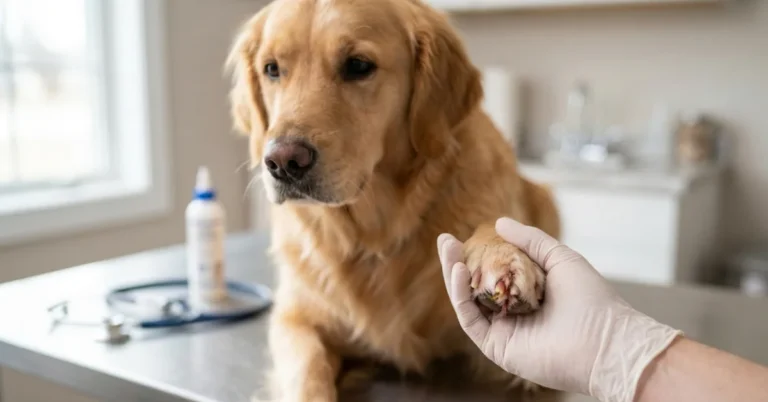
In a healthy paw, this skin should be flat and pale pink (or pigmented black). In an infected nail, the skin looks puffy, shiny, and angry red. It might feel warm to the touch compared to the other toes. If the swelling is severe enough, the toe itself might look like a little sausage.
Discoloration (reddish-brown nails)
Have you ever noticed the fur around your dog’s nails turning a rusty, reddish-brown color?
Many owners think this is just dirt or “tear stains” on the feet. In reality, this is often a hallmark sign of a yeast infection or chronic licking. The color comes from porphyrins, a compound found in saliva and tears that stains light fur upon contact. If the nail itself looks black (and it’s normally white) or has red streaks running through it, that can indicate bleeding or infection inside the nail shaft.
Pain, limping, and licking
Pain presents differently in every dog.
- The Lick: This is the most universal sign. If your dog is focused intently on one specific toe, licking it repeatedly, stop and check that toe. The saliva actually breaks down the skin further, so the licking makes the infection worse.
- The Flinch: When you are wiping their paws or trimming their nails, do they suddenly pull back? A dog that is usually good for nail trims who suddenly starts biting or pulling away likely has a painful infection.
- The Limp: You might notice a subtle “skip” in their step, or they might hold the paw up entirely. Often, the limp is worse on uneven ground (like gravel) where the sore nail gets pushed around.
Odor or discharge
Healthy dog feet have a scent (often described as popcorn or corn chips—which is actually a mild form of natural bacteria!), but they shouldn’t smell bad.
A yeast infection smells distinctly musty, like old cheese or a damp basement. A severe bacterial infection often smells metallic or like rotting garbage.
If you see discharge, that is an advanced infection. You might see:
- Pus: Thick, yellow or green fluid oozing from the cuticle.
- Serous fluid: Clear or slightly bloody sticky fluid.
- Crusts: Dried scabs around the base of the nail.
Safety Warning: If your dog is in pain, be very careful when inspecting the area. Even the sweetest dog can nip or bite reflexively when you touch a sore nail bed.
Types of Dog Nail Infections
To treat the problem effectively, we have to identify exactly what we are dealing with. In veterinary medicine, we categorize these infections based on the location and the organism involved.
Dog nail bed infection
When the infection is localized to the soft tissue around the nail, we call it Paronychia.
This is essentially the dog equivalent of a nasty hangnail or cuticle infection. The nail itself might still be intact and hard, but the skin around it is festering. This is usually bacterial and is extremely painful because of the swelling. You will often see the skin “ballooning” over the base of the nail. These are frequently caused by foreign bodies—like a grass awn or a splinter getting stuck right in the pocket of the nail fold.
Fungal nail infections in dogs
True fungal infection of the nail plate is called Onychomycosis.
This is different from a skin infection. Here, the fungus is actually eating the keratin of the claw. These nails look terrifying to owners—they become dry, brittle, and start to crumble away like chalk. The nail might grow in twisted or thickened shapes.
Ringworm is the most common culprit here. It’s vital to know that ringworm is zoonotic, meaning you can catch it from your dog. If you suspect this type of infection, wash your hands thoroughly after touching the paw.
Yeast infections affecting dog nails
I see yeast infections (Malassezia) more than any other type in my practice.
Unlike the crumbling of a fungal infection or the acute swelling of a bacterial one, yeast infections are usually greasy, smelly, and itchy. The nail bed will look wet and inflamed, and there is often a thick, brown, waxy discharge that accumulates in the claw sheath.
Yeast is rarely a primary problem; it’s almost always secondary to allergies (food or environmental). If we just treat the yeast on the nail but don’t address the allergy, the infection will come back within weeks.
Recognizing these signs is the first major step toward relief. But once you suspect an infection, the question becomes: Is this something you can handle with a soak at home, or do you need antibiotics? And how do we stop it from coming back?
In the next section, we will dive into how veterinarians diagnose these issues and the specific treatment plans—both medical and holistic—that actually work.
In Part 1, we covered how to spot the early warning signs of a nail infection. Now, we move to the action phase: diagnosis and treatment.
As a veterinarian, I know that the “wait and see” approach is tempting. No one wants to stress their dog out with a vet visit if a simple home remedy will do the trick. However, nail beds are tricky structures—they are essentially deep pockets that trap bacteria against the bone.
In this section, I’ll guide you through how we determine exactly what is wrong and how you can safely support healing at home.
How Dog Nail Infections Are Diagnosed
One of the hardest parts of being a dog owner is knowing when a problem is an emergency and when it can wait until morning.
When Home Observation is Enough
If your dog has a slightly red nail fold, is not limping, is still eating and playing normally, and allows you to touch the paw without yelping, you can usually try 24–48 hours of home care (which I will detail below). This is often just a minor irritation from rough play or allergies.
When Veterinary Diagnosis is Required
You need to see a vet if:
- There is pus or bleeding: Any discharge implies a deep infection that topical treatments likely won’t reach.
- The nail is loose or cracked: This exposes the nerve and requires pain management and often removal of the damaged shell.
- Your dog is limping: Limping equals pain. Dogs do not fake limps.
- The toe is swollen/hot: This suggests the infection is spreading to the deeper tissue (cellulitis) or even the bone (osteomyelitis).
Tests Vets May Use
When you bring your dog to me, I don’t just guess. We need to know who the enemy is—bacteria, yeast, or fungus?
- Cytology (The Tape Prep): This is the most common test I run. I take a piece of clear adhesive tape, press it against the infected nail bed to pick up cells and debris, and look at it under a microscope. This tells me instantly if we are fighting yeast (which looks like little footprints), bacteria (rods or spheres), or just inflammation.
- Bacterial Culture: If the infection looks nasty or isn’t responding to common antibiotics, I send a sample to a lab. They grow the bacteria to see exactly which antibiotic will kill it. This is crucial for resistant infections like MRSA.
- Fungal Culture (DTM): If I suspect ringworm, I pluck a few hairs or nail clippings and put them in a special gel. If the gel turns red over the next 1–2 weeks, it’s a positive result.
- X-rays: If a toe is persistently swollen, I worry about bone cancer or a bone infection. An X-ray rules this out.
Dog Nail Infection Home Treatment
If you’ve caught the infection early, or if you are supporting a treatment plan prescribed by your vet, home care is vital. The goal of home treatment is simple: Clean, Dry, and Protect.
Cleaning Infected Nails Safely
Do not scrub. The tissue is already angry. Gentle mechanical removal of debris is what we want.
Use a soft washcloth or gauze pad with warm water to wipe away any visible crust or mud. If there is hair matting around the nail, carefully trim it back (or have a groomer do it) so the area can breathe. Airflow is the enemy of fungus and bacteria.
Antiseptic Soaks
“Some links in this guide may be affiliate links. This does not affect our recommendations.”
Soaking is the gold standard for paw issues. It helps draw out inflammation and disinfects the nooks and crannies of the nail fold.
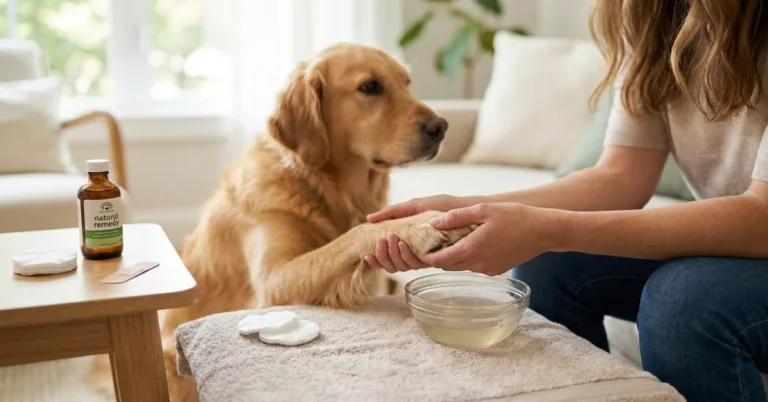
- Epsom Salt Soak: Mix 1/2 cup of plain Epsom salts (magnesium sulfate) into a gallon of warm water. Do not use scented bath salts with eucalyptus or peppermint, as these oils can sting or be toxic. Soak the paw for 5–10 minutes, twice a day. The magnesium helps reduce swelling and soothe the ache.
- Note: Do not let your dog drink the water. Epsom salts are a laxative and will cause diarrhea if ingested.
- Dilute Chlorhexidine or Betadine Soak: You can buy Chlorhexidine (2% or 4%) or Povidone-iodine (Betadine) at most pharmacies.
- The dilution is key: You want it to look like weak tea (for Betadine) or be very dilute (for Chlorhexidine).
- Soak for 5 minutes. This kills surface bacteria and yeast effectively.
Keeping the Nail Dry and Protected
This is where most owners fail. If you soak the paw and then let the dog run off with a wet foot, you’ve just created a warm, wet environment for the bacteria to regrow.
After soaking, pat the paw completely dry with a clean towel. Be sure to dry between the toes and around the nail base.
If you must walk your dog outside in the rain or mud while they are healing, use a protective bootie or even a thicker plastic bag secured loosely with vet wrap—but only for the duration of the walk. Take it off the second you get inside. We want the nail to “breathe.”
Preventing Licking and Chewing
I know nobody likes the “Cone of Shame” (Elizabethan collar), but for nail infections, it is non-negotiable.
Saliva is not antiseptic; it is full of oral bacteria. Every time your dog licks that infected nail, they are re-infecting it and keeping it wet. You cannot heal a nail infection if the dog is allowed to lick it. If you can’t watch them 100% of the time, the cone must go on.
Dog Nail Bed Infection Home Treatment
When the infection is deep in the nail bed (Paronychia), the pressure is intense.
- Warm Compresses: If your dog won’t tolerate a soak, a warm, wet washcloth held against the nail bed for 5 minutes can help open the pores and encourage drainage.
- Do Not Squeeze: If you see a pocket of pus, do not try to squeeze it like a pimple. You risk rupturing the infection inward into the bloodstream or damaging the growth plate of the nail. Let the warm water do the work of drawing it out.
- Topical Antibiotics: If your vet prescribes an ointment, apply it after the soak and dry routine. Rub it gently into the cuticle area so it penetrates.
Dog Nail Fungal and Yeast Infection Treatment
Fungal (Ringworm) and Yeast (Malassezia) infections are different beasts. They are stubborn and slow to heal.
How Fungal/Yeast Infections Differ
Bacteria multiply every 20 minutes; fungus multiplies much slower. This means killing fungus takes a long time. While a bacterial infection might look better in 3 days, a fungal nail infection might look the same for three weeks before turning a corner.
Why Treatment Takes Longer
The nail is made of keratin, which is hard and relatively impermeable. Getting antifungal medication to penetrate through the hard shell to kill the fungus living inside is difficult.
Importance of Consistency
If your vet gives you an antifungal spray, wipe, or oral medication, you must finish the course.
- Yeast: Usually requires 2–4 weeks of treatment.
- Ringworm: Can require months of treatment until the infected nail grows out completely and is replaced by healthy nail.
For yeast, I often recommend an antifungal mousse or spray containing Miconazole or Ketoconazole. You have to apply this daily. Skipping days allows the yeast to flare right back up.
What NOT to Do When Treating an Infected Dog Nail
In the age of the internet, I see a lot of scary home remedies. Please, for your dog’s safety, avoid these common mistakes.
Dangerous Home Remedies
- Hydrogen Peroxide: Do not use this on a nail infection. While the fizzing looks like it’s working, peroxide actually damages healthy skin cells and delays healing. It is too harsh for inflamed tissue.
- Tea Tree Oil: This is highly toxic to dogs if ingested and can cause severe skin burns. Never use “human” essential oil blends on dog paws.
- Bleach: Never soak a dog’s paw in bleach, even diluted. It is caustic and painful.
Over-Trimming
If the nail is infected, do not try to trim it short to “get rid of the infection.” The quick is likely swollen and longer than usual. If you cut into an infected quick, you will cause massive bleeding and excruciating pain. Leave the trimming to the professionals until the infection is under control.
Ignoring Pain Signs
If your dog is shivering, hiding, or refusing to eat, the pain is severe. Home remedies are not enough. Pain management (like NSAIDs prescribed by a vet) is often a necessary part of treating nail infections. Never give human pain relievers (Tylenol, Ibuprofen) to dogs—they can be fatal.
Healing a nail infection is a process. It rarely resolves overnight. With bacterial infections, you should see improvement within 48 hours of starting treatment. With fungal issues, you are in for the long haul.
But what happens when the infection is gone? How do you prevent this from becoming a monthly ordeal? In Part 3, we will cover the long-term prevention strategies, diet changes, and maintenance routines to keep those paws pristine.
We have covered what nail infections are and how to treat them. Now, we arrive at the part of the journey every owner looks forward to most: the finish line.
In this final section of our guide, I want to manage your expectations about healing, because nothing is more frustrating than thinking a problem is fixed, only to have it flare up again a week later. I also want to arm you with the preventative strategies that will keep you out of my waiting room in the future.
How Long Does a Dog Nail Infection Take to Heal?
This is the number one question I get once treatment starts: “Doc, when will he be back to normal?”
The answer depends entirely on what we are treating.
Bacterial Infections
If you are dealing with a standard bacterial paronychia (nail bed infection) and you catch it early, you usually see a dramatic improvement quickly.
- 24–48 hours: Pain and acute redness should start to subside.
- 5–7 days: Swelling should be significantly reduced.
- 10–14 days: The tissue should look completely normal.
However, if the infection was deep or involved a broken nail that had to be removed, the soft tissue will heal in about two weeks, but the new nail shell will take months to grow back.
Fungal and Yeast Infections
These are the marathon runners of nail issues.
- Yeast (Malassezia): With diligent daily treatment (wipes/mousse), the itching usually stops within 3–5 days, but the redness and brown staining take 2–4 weeks to clear. If you stop treatment the moment the itching stops, it will come back.
- Ringworm: This is the slowest healer. Because the fungus lives inside the hard keratin, we often have to wait for the infected part of the nail to grow out completely. A dog’s nail grows relatively slowly. Complete resolution can take 3 to 6 months.
Signs of Improvement vs. Trouble
Good Signs:
- Your dog stops licking the paw.
- The “angry” red color fades to pink.
- The swelling goes down (you can see the definition of the toe bones again).
- No more discharge.
When Healing is Not Normal: If you have been treating for 5 days and the paw is more swollen, or if the redness is spreading up the leg, the treatment isn’t working. This often means there is a resistant bacteria involved, or perhaps a foreign body (like a thorn) is still stuck inside the tissue.
How to Prevent Dog Nail Infections
I am a huge believer that an ounce of prevention is worth a pound of cure (and hundreds of dollars in vet bills). Most nail infections are opportunistic—they happen because the nail was weakened or the environment was right. Here is how you lock the door against them.
Proper Nail Trimming Habits
Long nails are the root of so much evil in paw health. When a nail touches the ground, it pushes back into the nail bed with every step. This constant mechanical jamming causes chronic inflammation, which invites infection.
- The Rule of Thumb: You should not hear your dog’s nails clicking on the floor. If you hear click-click-click, they are too long.
- Trim Little and Often: Instead of a stressful wrestling match once a month, try to trim just the tiny tips of the nails every week. This forces the “quick” (the blood vessel) to recede, allowing you to keep the nails shorter over time without bleeding.
- Sanitize Your Tools: If you have multiple dogs, or if your dog has had an infection before, wipe your clippers with rubbing alcohol between dogs. You can absolutely spread fungus from one dog to another via dirty clippers.
Keeping Nails Clean and Dry
Moisture is the best friend of yeast and bacteria.
- The Post-Walk Routine: Keep a towel by the door. When you come in from wet grass, rain, or snow, dry those paws. Don’t just wipe the tops; get the towel in between the toes and around the nail beds.
- Manage Paw Hair: If your dog has Grinch-feet (long tufts of hair between the pads), trim that hair flush with the pads. That hair acts like a sponge, holding dirty water against the nail bed for hours.
Regular Inspection Tips
Make “paw checks” a normal part of your cuddle time. Once a week, when your dog is relaxed, gently handle each toe.
- Look for cracks or splits in the hard shell.
- Check the base of the nail for that tell-tale reddish-brown staining.
- Smell the feet. Seriously. If they smell cheesy or musty, you likely have a yeast bloom starting. Catching it now with a few days of antiseptic wipes is much easier than treating a full-blown infection later.
Diet and Immune Health Support
Chronic nail infections often point to a systemic issue.
- Omega-3 Fatty Acids: Fish oil is fantastic for skin and nail health. It improves the skin barrier, making it harder for bacteria to enter.
- Allergy Management: If your dog gets nail infections every spring and fall, they likely have environmental allergies. Treating the allergy (with your vet’s help) is the only way to stop the infections.
- High-Quality Protein: Nails are made of keratin, which is a protein. A poor diet can lead to brittle, cracking nails that infect easily.
When to See a Vet Immediately
While I encourage home monitoring, there are times you need to drop everything and go to the clinic.
- Uncontrollable Pain: If your dog cannot put weight on the foot, is shaking, panting, or won’t let you near the paw.
- Spreading Redness: If the redness is moving from the toe up the leg, this could be cellulitis or sepsis, which is life-threatening.
- Broken Nail with Exposed Quick: If the hard shell has ripped off and the bloody, raw center is hanging out, this is excruciating. It needs to be surgically removed and bandaged under sedation.
- Bleeding that Won’t Stop: Nail beds are vascular. If it has been bleeding for more than 10 minutes despite pressure, you need help.
Frequently Asked Questions About Dog Nail Infection Treatment
In my years of practice, these are the questions I hear most often.
Can dog nail infections heal on their own?
Rarely. A mild irritation might resolve if you keep it clean and dry, but a true infection (bacteria or fungus) usually needs help. Because the nail bed is a dark, warm pocket, the body struggles to clear infections there without the aid of antiseptics or antibiotics. Ignoring it usually leads to a much deeper, more painful problem.
Are dog nail infections contagious?
It depends on the cause.
Bacterial: Generally no. You won’t catch a staph infection just by touching your dog’s toe, though you should always wash your hands.
Yeast: No. Yeast is not contagious to you or other pets; it’s an overgrowth of natural flora.
Ringworm (Fungus): YES. Ringworm is highly contagious to humans, cats, and other dogs. If a diagnosis of ringworm is confirmed, you need to handle your dog with gloves and wash all bedding in hot water.
Can I walk my dog with a nail infection?
Yes, but with precautions. Exercise is good for the immune system. However, you must protect the paw. Walking on mud, salted sidewalks, or abrasive concrete can hurt. Use a dog bootie for the walk, but take it off immediately when you get inside to let the paw breathe.
Can I use human antifungal products?
Sometimes, but check with your vet. Over-the-counter creams for athlete’s foot (like Clotrimazole) are often safe for dogs, but dogs lick them off. This renders the cream useless and can upset their stomach. Veterinary products usually come in sprays or rapid-dry mousses that are harder to lick off and safer if ingested.
Final Veterinary Advice for Dog Owners
If there is one thing I want you to take away from this guide, it is this: Your dog’s paws are their connection to the world.
When that connection is painful, their whole world shrinks. They don’t want to play, they don’t want to walk, and their quality of life suffers.
Don’t beat yourself up if your dog gets a nail infection. They happen to the best-cared-for dogs. The measure of a great owner isn’t preventing every single scrape or germ; it’s noticing when something is wrong and acting on it with compassion.
Trust your gut. You know your dog better than anyone. If something looks “off,” if that one toe looks a little too puffy, or if they hesitate before jumping into the car—take a look. A simple cleaning and a few days of rest now is always better than a month of antibiotics later.
Disclaimer: This guide is for educational purposes only and does not constitute veterinary advice. Every dog is unique. If you suspect your dog has a medical condition, please consult with your licensed veterinarian for a physical exam and personalized treatment plan.
5 Comments