
Table of Contents
In my clinical practice, one of the most common questions I get after a dog loses a nail is, “Doctor, is it gone forever?”
I understand the worry. A missing nail looks odd, and the exposed tissue underneath can seem frighteningly fragile. Whether the nail was lost due to a snag on the carpet or a necessary removal during a vet visit, the waiting game that follows can be stressful for a caring owner. You find yourself checking the paw every day, wondering if that tiny bump of tissue is actually a new nail or if something is wrong.
The good news is that the body is incredibly resilient. Nail regrowth is a natural biological process, but it is also a slow one. Unlike skin, which heals in days, nails take weeks and months to regenerate.
This article is designed to walk you through the timeline of nail regrowth. We aren’t going to talk about treating injuries or fighting infections here; we are simply going to look at the biology of how a dog’s nail rebuilds itself, stage by stage, so you know exactly what is normal and what to expect.
Do Dog Nails Grow Back?
The short answer is: Yes, in the vast majority of cases, dog nails do grow back.
However, there is a caveat. The nail will only regrow if the “germinal cells” (the specialized cells responsible for creating the hard shell) at the very base of the nail bed are still intact. Think of this like a flower bulb; as long as the bulb is healthy in the soil, the flower will grow back even if the stem is cut. In most nail issues I see, the damage is to the hard shell, leaving the root system safely tucked away inside the toe.
That said, regrowth is a test of patience. It is not an overnight event. It is a slow, gradual pushing out of new material. Understanding this helps manage the anxiety of “why isn’t it growing yet?”—often, it is growing, just at a pace that is hard to see day-to-day.
Understanding How Dog Nails Grow
To understand regrowth, you have to understand what a dog’s nail actually is. It isn’t just a solid piece of hard material like a rock. It is a complex, living structure.
A dog’s nail consists of two main parts:
- The Ungual Process (The Quick): This is the living core. It contains blood vessels and nerves and is attached to the bone of the toe.
- The Nail Shell (The Claw): This is the hard, keratinized outer layer that protects the quick.
Growth begins at the coronary band (or the nail matrix), which is the rim of tissue right where the skin of the toe meets the nail. This is the “factory” where new cells are born. As these cells reproduce, they harden (keratinize) and are pushed forward, covering the quick and forming the hard shell.
Every dog grows nails at a different speed. I often tell clients that nutrition, age, and general health play a huge role. A young, healthy puppy will regrow a nail much faster than a senior dog with a slower metabolism.
Dog Nail Regrowth Stages Explained
When a nail is lost or removed, the regrowth process generally follows four distinct stages. While every dog is different, this is the typical progression I see in the clinic.
Stage 1 – Early Healing Phase
Timeline: The first 1-2 weeks.
Immediately after the nail is lost, the goal of the body is not to grow a new nail, but to protect the exposed sensitive tissue. During this phase, you likely won’t see any “nail” at all.
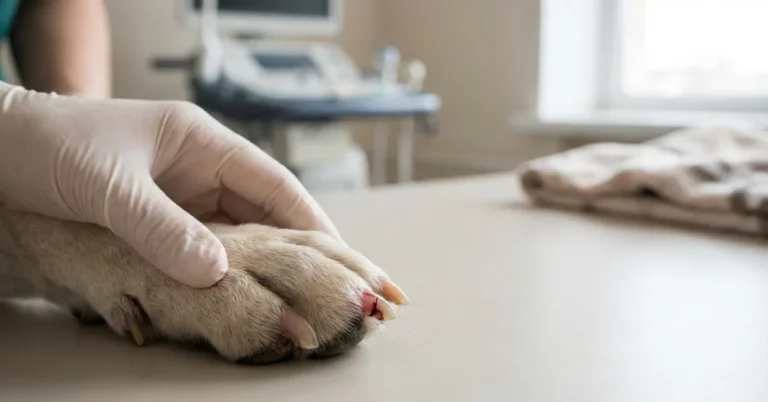
Instead, you will see the exposed nail bed (the quick). Initially, this tissue is moist, tender, and usually pink or red. Over the first week or so, this soft tissue begins to dry out. It forms a protective, dry layer—almost like a callous or a scab—over the sensitive nerves.
During this stage, the area is very sensitive. Dogs often hold the paw up or lick at it because the “armor” of the hard nail is missing. This is a quiet phase where the cellular machinery at the base is just waking up, preparing to start production.
Stage 2 – Initial Nail Regrowth
Timeline: Weeks 2-4.
This is the stage where owners usually get excited because they finally see “something” happening.
You will start to notice a thin, rim-like projection emerging from the skin fold at the base of the toe. It doesn’t look like a normal, thick dog claw yet. It often looks like a thin, fragile sheet of fingernail material.
This new growth is often soft and pliable compared to a mature nail. It is covering the very base of the dried-out quick. It might look uneven or slightly rough. This is normal. The “factory” is just starting up, and the initial production can be a bit irregular. The dog is usually less sensitive now, but the new nail provides very little structural protection.
Stage 3 – Nail Strengthening and Thickening
Timeline: Month 2 to Month 4.
This is the longest phase of the process. The nail is now visibly growing outward, extending down the length of the quick.
However, length isn’t the only thing happening here; thickness is developing. As the nail grows longer, it also grows denser. The keratin becomes harder and more opaque.
You might notice a distinct “line” or ridge on the nail, separating the new growth from the old nail bed. The new nail might look slightly different in color or texture than the other nails on the paw—perhaps a bit bumpier or wider. This is often because the nail bed is not as tightly compressed as it was before the loss.
During this stage, the nail is strong enough to offer some protection, and most dogs return to normal walking habits, though the nail may not touch the ground yet.
Stage 4 – Full Nail Formation
Timeline: Month 4 to Month 6 (or longer).
Eventually, the new nail shell reaches the tip of the quick and extends beyond it to form the hook or curve that we recognize as a normal dog claw.
By this stage, the keratin has hardened completely. The surface should smooth out over time as the nail is worn down by walking. The quick inside usually lengthens along with the nail, regaining its normal shape.
Ideally, at the end of this stage, you shouldn’t be able to tell which nail was the one that was regrowing, although some dogs will always have a slightly “quirky” nail that is a bit thicker or crooked compared to its neighbors.
How Long Do Dog Nail Regrowth Stages Take?
I wish I could give every client a calendar date for when the nail will be perfect, but biology doesn’t work that way.
Average Timelines:
- Small Dogs: 3 to 5 months.
- Large/Giant Dogs: 4 to 9 months.
Why the difference? Large dogs simply have larger nails to produce. It takes more keratin and more time to cover a Great Dane’s toe than a Chihuahua’s.
Factors Influencing Speed:
- Season: believe it or not, hair and nail growth can slow down slightly in colder months and speed up in warmer months due to blood flow and hormonal changes.
- Activity: Mild stimulation (walking on varied surfaces) can stimulate blood flow to the paws, which can encourage growth, whereas total inactivity might slow it down slightly.
- Nutrition: A dog eating a high-quality, balanced diet has the building blocks (proteins and vitamins) needed for keratin production.
Patience is Key: I cannot stress this enough—do not watch the nail grow. It is like watching paint dry. If you check it every four hours, you will think nothing is happening. Check it once a week. You will see progress much more clearly that way.
What Is Normal vs Not Normal During Nail Regrowth
As a veterinarian, I rely on owners to be the daily observers. Here is a guide on what you should expect versus what might warrant a second look.
Normal:
- Uneven Surface: New nails often have ridges or bumps. This usually smooths out as the nail grows and is worn down.
- Discoloration: The new nail might be a slightly different shade than the original. A black nail might grow back dark gray; a white nail might grow back more opaque.
- Slow Growth: A week of “no change” is often just a slow week.
Warranting Observation (Not necessarily an emergency, but keep an eye on it):
- Curling Inwards: Sometimes, a damaged nail matrix produces a nail that grows straight down or curls into the pad rather than outward. This requires veterinary trimming.
- Splitting: If the new, thin nail splits down the middle as it grows, the nail bed might be permanently damaged.
- Stoppage: If the nail grows halfway and then never advances for months, the germinal cells may have been damaged, and that may be the maximum length the nail will reach.
Supporting Healthy Nail Regrowth
While you cannot force the nail to grow faster, you can create the right environment for it to grow well.
Clean Environment: During the early stages, keep your dog’s bedding clean. Walking in mud or dirty water while the nail is in Stage 1 (soft tissue healing) can irritate the area.
Activity Moderation: In the early stages, intense scrambling on rocks or gravel can scrape the delicate new keratin (Stage 2) before it has hardened. Moderate, controlled leash walks are better than wild off-leash running until the nail has hardened (Stage 3).
Regular Observation: Make a habit of looking at the underside of the nail. Sometimes the top looks fine, but the underside reveals that the nail isn’t adhering to the quick properly.
Common Myths About Dog Nail Regrowth
There is a lot of misinformation at the dog park. Let’s clear up a few myths.
Myth: “The nail will grow back in two weeks.” Fact: Impossible. Even the fastest-growing nails take months to fully regenerate. Two weeks is barely enough time for the skin to heal, let alone a hard keratin shell.
Myth: “Regrowth is always perfect.” Fact: Trauma changes things. Just like a scar on skin looks different, a regrown nail is often thicker, wider, or slightly more brittle than the original “factory part.”
Myth: “All nails regrow at the same rate.” Fact: If your dog lost two nails, one might finish growing a month before the other. It depends on the blood supply to that specific toe and the extent of the damage to the individual root.
This article may contain affiliate links. We may earn a small commission at no extra cost to you.
Frequently Asked Questions
Will my dog’s nail grow back fully?
In most cases, yes. Unless the trauma was severe enough to surgically remove or destroy the nail matrix (the root factory), the body will attempt to produce a new nail.
Why does regrowth look uneven at first?
The “factory” (matrix) was likely bruised or swollen from the initial incident. When it starts producing nail again, it sputters a bit. As the swelling subsides and health returns, the nail usually smooths out, but the tip (the first part grown) often looks rough.
Should I trim a regrowing nail?
Not for a long time. You generally want to avoid trimming the new nail until it has grown past the quick and is starting to curl or touch the floor. Premature trimming can crush the fragile new keratin structure.
Can nail regrowth stop halfway?
It is rare, but possible. If the nail bed was partially scarred, the nail may grow to a “stump” and stop. This is usually cosmetic and doesn’t bother the dog, provided the stump doesn’t get ingrown.
Final Veterinary Advice for Dog Owners
The process of watching a nail regrow is a lesson in biology and patience. It is a slow, quiet recovery that happens in the background of your dog’s life.
If you are currently watching a paw, waiting for that familiar claw to reappear, take a deep breath. Nature knows what it is doing. Your role is simply to provide a safe, clean environment and to let time do its work.
Monitor the progress week by week, not hour by hour. And remember, if the regrowth ever looks painful, distorted, or simply “wrong” to you, your veterinarian is there to take a look. We can often assess in seconds whether a nail is growing on track or if it needs a little help.
Disclaimer: This article is for informational purposes only and describes the general biological process of nail regrowth in dogs. It does not constitute specific medical advice. If you are concerned about your dog’s recovery or nail health, please consult your veterinarian.
5 Comments